


- 83 Views
- 13 Min Read
- (0) Comment
TL;DR:
- During World War II, thousands of Polish women and children displaced by Soviet deportations found refuge in Uganda, building churches and schools amidst local communities. Their remarkable story highlights resilience, cross-cultural bonds, and lasting heritage sites like the Nyabyeya church that remain active today. This overlooked chapter offers a unique intersection of refugee history, colonial dynamics, and Ugandan-Polish relations worth exploring firsthand.
Few chapters of World War II history are as unexpected as the forgotten Polish history in Uganda. Between 1942 and 1948, thousands of Polish women and children, survivors of brutal Soviet deportations, found sanctuary in the green highlands of East Africa rather than the war-ravaged cities of Europe. They built churches, schools, and hospitals. They forged genuine friendships with local Ugandans. And when the war ended, most never went home. Their story sits at the intersection of global conflict, colonial Africa, and extraordinary human resilience, and it remains one of the most overlooked chapters in both Polish and Ugandan national memory.
Table of Contents
- Key Takeaways
- Forgotten Polish History in Uganda: the road from Siberia
- Life inside the Ugandan refugee camps
- Cross-cultural bonds and colonial tensions
- The legacy and preservation of Polish heritage sites
- Heritage tourism: combining history with Uganda safaris
- My perspective on this overlooked chapter
- Explore Uganda’s history and wildlife with PawMac Safaris
- FAQ
Key Takeaways
| Point | Details |
|---|---|
| Soviet deportations drove the exodus | Hundreds of thousands of Poles were deported to Siberian labor camps starting in 1939, setting the refugee crisis in motion. |
| The Sikorski-Mayski agreement was the turning point | Signed July 30, 1941, this diplomatic agreement granted amnesty to Poles in the USSR and opened the path to Uganda. |
| Uganda hosted over 7,000 Polish displaced people | Camps at Koja and Nyabyeya (Masindi) sheltered mainly women and children from 1942 to 1948. |
| Cross-cultural bonds defied colonial norms | Polish refugees treated native Ugandans as equals, creating relationships that stood in sharp contrast to British colonial policies. |
| Heritage sites survive today | The Our Lady Queen of Poland church and refugee cemeteries remain standing and are actively commemorated. |
Forgotten Polish History in Uganda: the road from Siberia
To understand how Polish refugees ended up in Uganda, you have to start in the frozen east. When the Soviet Union invaded eastern Poland on September 17, 1939, following the Molotov-Ribbentrop Pact, it began a systematic campaign of mass deportations. Polish civilians, military families, teachers, priests, and farmers were loaded onto cattle cars and sent to Siberian labor camps and remote settlements known as gulags. Estimates suggest that between 320,000 and one million Poles were deported in four major waves between 1939 and 1941.
The conditions were catastrophic. Families were separated. Children died of typhus and starvation. The fate of deported Poles only began to shift in mid-1941, specifically on July 30, 1941, when the Sikorski-Mayski agreement was signed between the Polish government-in-exile and the Soviet Union. This diplomatic breakthrough granted amnesty to all Poles held in Soviet camps, releasing them from forced labor and allowing them to organize under General Władysław Anders.
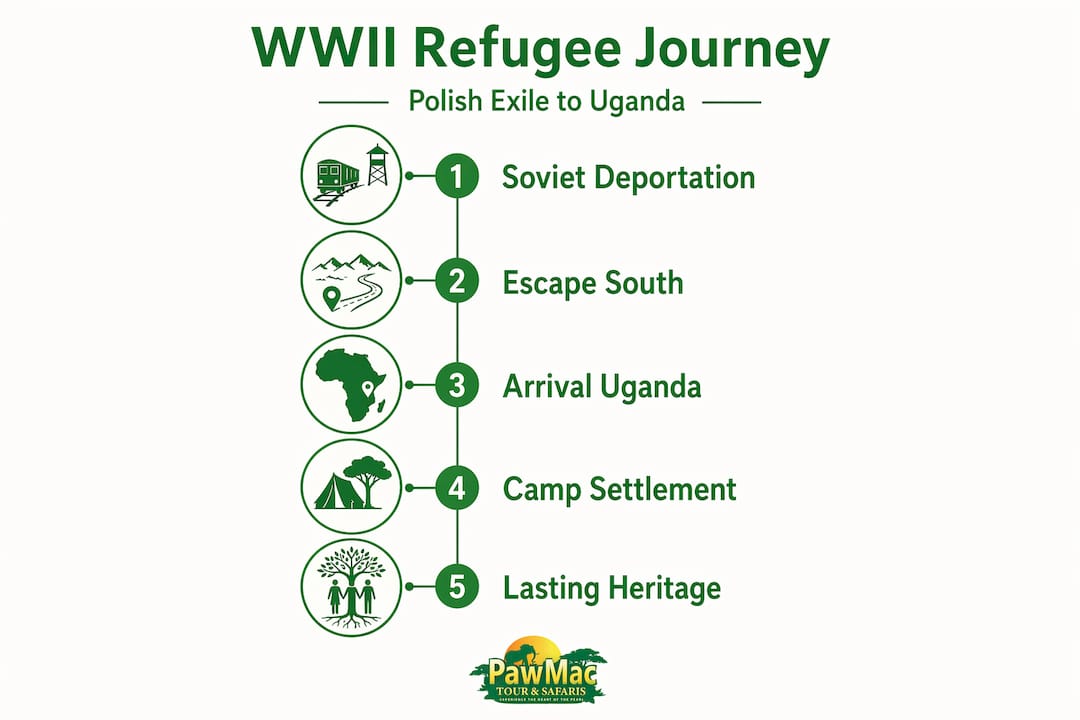
The evacuation route that followed was extraordinary. Survivors traveled south through the USSR into Iran, then onward through British-controlled territories. From the Middle East, many were redirected to East Africa. Refugees arrived by rail from Kenya into Uganda between 1942 and 1945, settling into camps that the British colonial administration had designated in remote, rural areas far from urban centers.
Key stops along the evacuation route included:
- Soviet labor camps in Siberia and Kazakhstan (point of origin)
- Pahlavi (modern Bandar Anzali), Iran (first major transit point)
- Karachi and Bombay (secondary transit hubs)
- Mombasa (East African entry point)
- Uganda via the Kenya-Uganda Railway (final destination for thousands)
Pro Tip: Researchers tracing individual refugee journeys should cross-reference Soviet-era deportation records with British colonial administrative files held at the National Archives in London, as both sources are needed to reconstruct complete family histories.
Life inside the Ugandan refugee camps
Uganda hosted over 7,000 Polish displaced people across its wartime settlements, with the two primary sites being Koja in Mukono District on the shores of Lake Victoria, and Nyabyeya in Masindi District near the Budongo Forest. The population skewed heavily toward women and children. Many fathers and husbands had either died in Soviet camps, joined the Anders Army, or remained missing. These were survivors rebuilding life from almost nothing.
The scale and self-sufficiency of these settlements is remarkable in retrospect. The refugees did not simply wait out the war in temporary shelters.
| Camp | Location | Peak Population | Key Structures |
|---|---|---|---|
| Koja | Mukono District, Lake Victoria | ~3,500 | Cemetery, chapel, administrative buildings |
| Nyabyeya | Masindi District, Budongo Forest | 3,200–3,600 (by 1944) | Our Lady Queen of Poland Church, school, hospital |
Nyabyeya grew to approximately 3,200 to 3,600 refugees by 1944, and the community built institutions that would serve both the refugees and the surrounding area. Schools ran full academic programs. A hospital provided medical care. Cultural organizations kept Polish language, music, and religious tradition alive under the equatorial sun.
Plan Your Uganda Safari with Local Experts
 WhatsApp Us
The crown jewel of this communal effort was the Our Lady Queen of Poland Catholic Church at Nyabyeya, constructed between 1943 and 1945 using brick and local materials. The church bears inscriptions in four languages, including Polish, Latin, and local Ugandan languages, along with the Polish coat of arms. It still stands today and remains an active place of worship. That a community of traumatized wartime refugees built a multilingual, permanent structure in the middle of equatorial Africa is one of the most striking facts in this entire story.
Daily life in the camps combined:
- Formal schooling for children, with Polish-language curricula maintained throughout
- Agricultural work and food production to reduce dependence on British colonial supply chains
- Religious observance as a central pillar of community identity
- Cultural performances, theater, and scouting activities
- Employment of local Ugandan laborers in construction and camp maintenance
Pro Tip: The physical remnants of camp life, including church inscriptions and cemetery layouts, provide material evidence for reconstructing refugee history that documents alone cannot fully capture. Any serious field researcher should visit both Koja and Nyabyeya as distinct historical nodes rather than treating them as interchangeable sites.
Cross-cultural bonds and colonial tensions
The social dynamics inside and around the camps were more complex than a simple story of European refugees in Africa. Polish refugees were categorized as “poor whites” by British colonial administrators, a designation that placed them awkwardly within the rigid racial hierarchy of colonial Uganda. They were European, so they could not be treated as colonial subjects. But they were destitute, politically stateless, and dependent on British charity, so they did not fit neatly into the privileged settler class either.
This ambiguity had real consequences. The British administration placed camps in remote areas partly to keep the refugees out of sight and away from urban centers where their poverty might disrupt the visual order of colonial society. The remoteness was isolating, but it also created an unexpected outcome.
“Polish refugees treated native Ugandans as equals and formed deep bonds, differing markedly from British colonial officials.” — New Lines Magazine
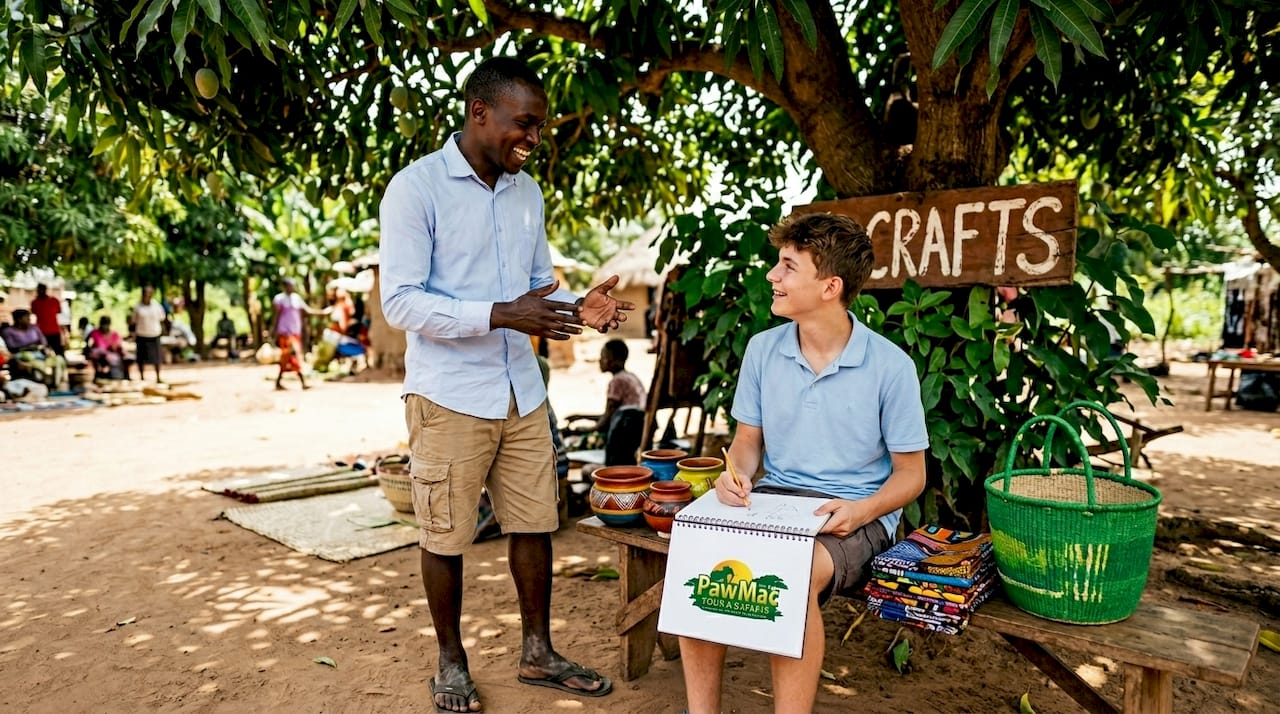
Without the social conditioning of colonial privilege, many Polish refugees interacted with local Ugandans on genuinely human terms. African laborers worked alongside refugees in construction and agriculture. Local askaris (soldiers) provided security. Friendships formed across language barriers. Children played together. These were not the sanitized, managed interactions of colonial paternalism. They were the messy, real connections of people sharing difficult circumstances.
The contrast with British colonial behavior was not lost on Ugandans at the time. Several oral history accounts collected by researchers describe local communities remembering the Poles with warmth, specifically noting their willingness to share food, greet people by name, and work alongside African laborers rather than directing them from a distance.
This episode reveals something important about how colonial racial hierarchies actually functioned. The Poles simultaneously occupied a privileged position by virtue of their European identity and a marginalized one by virtue of their poverty and statelessness. That contradiction disrupted the clean racial logic of British colonialism in ways that neither the British administration nor the refugees themselves fully anticipated.
The legacy and preservation of Polish heritage sites
When World War II ended in 1945, the question of what would happen to the refugees became urgent. After WWII ended, camps closed and refugees dispersed worldwide rather than returning to Soviet-controlled Poland. For most, going home was not a real option. Poland had fallen under Soviet domination, and returning meant potential arrest, persecution, or a return to the very system they had barely survived. The camps began closing in 1948, with the last settlements winding down by 1951.
The diaspora scattered across the globe:
- A significant portion resettled in the United Kingdom, where the Polish Resettlement Act of 1947 provided a legal pathway.
- Others emigrated to Australia, Canada, and the United States under various postwar immigration programs.
- A smaller number settled in France, Argentina, and other countries with existing Polish diaspora communities.
- Very few returned to communist Poland, and those who did often faced surveillance and discrimination.
What they left behind in Uganda was not forgotten entirely. The Our Lady Queen of Poland church at Nyabyeya survived and continues to serve the local Catholic community. The refugee cemeteries at Koja and Nyabyeya remain, maintained through a combination of local care and international effort.
| Heritage Site | Current Status | Preservation Effort |
|---|---|---|
| Our Lady Queen of Poland Church, Nyabyeya | Active place of worship | Local parish and Polish diaspora organizations |
| Koja refugee cemetery | Maintained, annually commemorated | NEVER AGAIN Association, local communities |
| Nyabyeya settlement remnants | Partially preserved | Educational initiatives, heritage tourism |
The Koja Polish refugee graveyard is commemorated annually through candle-lighting ceremonies organized by groups including the NEVER AGAIN Association, which has worked to connect this history to contemporary conversations about refugee solidarity. Makerere University in Kampala has also engaged with this history as part of broader intercultural education programs. The Uganda Railway Museum’s exhibition has reframed Polish refugee arrivals as part of Uganda’s broader humanitarian and cultural heritage, giving the story a public platform it previously lacked.
Heritage tourism: combining history with Uganda safaris
The sites connected to the history of Poles in Uganda are not just for scholars. They represent a genuinely rare opportunity for heritage travelers who want to go beyond the standard safari itinerary. Masindi, the district that includes the Nyabyeya settlement, is also the gateway to Murchison Falls National Park, one of Uganda’s most dramatic wildlife destinations. That geographic overlap is not a coincidence for the heritage traveler. It is an invitation.
Visitors exploring the forgotten stories of Uganda through a heritage lens can build itineraries that include:
- The Our Lady Queen of Poland Church at Nyabyeya, where the multilingual inscriptions and original architecture provide a direct, physical connection to the refugee community
- The Koja cemetery on Lake Victoria, accessible from Kampala and offering a contemplative site of memory
- The Uganda Railway Museum in Kampala, which contextualizes the refugee rail journey within Uganda’s broader history
- Murchison Falls National Park, just north of Masindi, for wildlife experiences that complement the historical visits
The Polish diaspora in Africa left behind a cultural footprint that is genuinely unique on the continent. No other African country hosted a wartime Polish refugee settlement of this scale. For researchers, the sites at Koja and Nyabyeya offer primary material evidence. For travelers, they offer a profound and unexpected layer of human history in a country already rich with natural wonders. PawMac Safaris has the local expertise to weave these sites into custom safari itineraries that honor both the wildlife and the history of Uganda.
My perspective on this overlooked chapter
I have spent years helping travelers discover Uganda’s layers, and this particular history still surprises me every time I share it. Most people arrive thinking of Uganda purely in terms of gorillas and the Nile. The idea that thousands of Polish women and children once built a brick church in the Budongo Forest, inscribed it in four languages, and then scattered across the world leaving it behind, that is not what anyone expects.
What strikes me most is not the drama of the evacuation, though that is extraordinary. It is the quality of the relationships that formed here. The Polish refugees arrived with nothing and yet managed to treat their Ugandan neighbors with a dignity that the colonial administration withheld by design. That is worth sitting with. It tells you something about how shared vulnerability can cut through the hierarchies that power constructs.
I also think researchers underestimate how much physical evidence remains. The church at Nyabyeya is not a ruin. It is a living building used by a living congregation. The cemeteries are tended. These are not sites you have to imagine. You can stand in them. For anyone serious about the impact of Polish immigrants in Uganda, fieldwork at these locations will give you things that no archive can.
My honest view is that this history deserves a permanent place in both Polish and Ugandan national curricula. It is a story about how two communities with no obvious reason to connect found common ground in extraordinary circumstances. That is a lesson worth teaching, and Uganda is the place to learn it firsthand.
— Paweł
Explore Uganda’s history and wildlife with PawMac Safaris
For travelers and researchers ready to experience this history on the ground, PawMac Safaris offers custom itineraries that combine Uganda’s world-class wildlife with visits to the Polish WWII heritage sites at Nyabyeya and Koja.

PawMac Safaris operates exclusively in Uganda with deep local knowledge and a genuine commitment to ethical, community-centered travel. The team uses comfortable 4×4 Safari Vans and handles all logistics, including national park permits and accommodation, so you can focus on the experience. A 3-day Murchison Falls safari can be extended to include the Nyabyeya settlement just south of the park, creating an itinerary that pairs elephant sightings and the thundering Nile with one of Africa’s most unexpected WWII stories. Browse the full range of Uganda safari packages or contact PawMac Safaris directly to request a personalized 2026 quote tailored to your interests.
FAQ
What was the Sikorski-Mayski agreement?
The Sikorski-Mayski agreement was signed on July 30, 1941, between the Polish government-in-exile and the Soviet Union. It granted amnesty to Poles held in Soviet labor camps and enabled the mass evacuation that eventually brought thousands of refugees to Uganda.
How many Polish refugees came to Uganda during WWII?
Uganda hosted over 7,000 Polish displaced people between 1942 and 1948, primarily women and children, settled in camps at Koja and Nyabyeya.
Does the Polish church in Uganda still exist?
Yes. The Our Lady Queen of Poland Catholic Church at Nyabyeya, built by refugees between 1943 and 1945, still stands and functions as an active place of worship, with original multilingual inscriptions intact.
Why didn’t Polish refugees return to Poland after WWII?
Most refugees chose not to return because postwar Poland fell under Soviet control. Returning meant potential persecution by the same system that had deported them in the first place, so the majority resettled in the UK, Australia, and other countries.
Can you visit Polish WWII heritage sites in Uganda today?
Yes. The Nyabyeya church, the Koja cemetery, and the Uganda Railway Museum in Kampala are all accessible. PawMac Safaris can incorporate these heritage site visits into custom safari itineraries, including trips to nearby Murchison Falls National Park.
Recommended
- Languages in Uganda: Essential Guide for Travelers
- Discover Uganda’s Animals: Safaris & Gorilla Trekking Guide
- How to Book Gorilla Trekking in Uganda: Step-by-Step Guide
- Uganda Safari Guide: Gorilla Trekking, Wildlife & Planning


