2026 Limited Dates
Gorilla Trekking Uganda Tours
Join our local PawMac Safaris guides for Bwindi & Mgahinga gorilla trekking. We handle your complete planning + booking.
TL;DR:
- Uganda has over 70 indigenous languages beyond English and Swahili.
- English dominates formal settings, while local languages thrive in rural communities.
- Learning basic greetings in regional languages enhances your authentic Uganda Safari experience and cultural connection.
Uganda surprises most visitors before they even set foot on a trail through Bwindi’s mist-shrouded rainforest. Many travelers assume English will be the only language they need, but the country’s official language status for both English and Swahili is just the beginning of the story. Beneath those two official tongues lies a vivid mosaic of over 70 indigenous languages, each tied to a distinct community, culture, and way of life. This guide helps you understand Uganda’s linguistic landscape so you can communicate more confidently, connect more deeply with local communities, and get far more out of every
Uganda Safari, village visit, and cultural encounter.
Table of Contents
Key Takeaways
Quick answer: English and Swahili are Uganda’s official languages, but travelers will hear many indigenous languages depending on the region. English is sufficient for most safari logistics and urban services. Luganda is especially useful around Kampala, while Rukiga, Acholi, Ateso, Lugbara, and other local languages become more prominent in their home regions.
| Point |
Details |
| Two official languages |
Uganda’s official languages are English and Swahili according to its constitution. |
| Over 70 languages spoken |
Travelers will encounter a vibrant mix of more than 70 local languages across the country. |
| Language varies by region |
Luganda, Ateso, Acholi, and Lugbara are regionally dominant and enrich your travel experience. |
| English is widely used |
English works well for most tourism and city situations, while local languages prevail in communities. |
| Connecting with locals |
Using greetings and learning a few local phrases greatly enhances cultural experiences during your safari. |
Quick answer: English and Swahili are Uganda’s official languages, but travelers will hear many indigenous languages depending on the region. English is sufficient for most safari logistics and urban services. Luganda is especially useful around Kampala, while Rukiga, Acholi, Ateso, Lugbara, and other local languages become more prominent in their home regions.
Uganda’s official and national languages: A constitutional overview
When you land in Kampala or begin your journey toward Queen Elizabeth or Murchison Falls National Park on a
Uganda Big Five safari, you will notice English everywhere. Road signs, hotel menus, government offices, and tour operators all operate in English. That is no coincidence. Uganda’s official language is English, with Swahili recognized as the second official language under the 1995 Constitution, Article 6.
English was inherited from British colonial administration and has remained the language of formal governance, law, education, and commerce ever since independence in 1962. Swahili, on the other hand, was elevated to official status as a strategic move to strengthen Uganda’s integration within the East African Community, alongside Kenya, Tanzania, Rwanda, and Burundi. In practice, Swahili is used in military and police communications, some business settings, and increasingly in border towns.
“The Constitution of Uganda recognizes both English and Swahili as official languages, while also permitting the use of other languages in schools and cultural settings, affirming that linguistic diversity is a national asset rather than a barrier.”
For travelers, this means you can navigate most formal settings, tourist lodges, and national park offices entirely in English. However, the moment you step into a local market, a rural village near Bwindi, or a community around Mgahinga Gorilla National Park, you enter a world where indigenous languages take center stage.
Here is a quick comparison of Uganda’s two official languages:
| Feature |
English |
Swahili |
| Constitutional status |
Primary official language |
Second official language |
| Main usage |
Government, law, education, tourism |
Military, police, border trade, East African integration |
| Prevalence in cities |
Very high |
Moderate |
| Prevalence in rural areas |
Moderate |
Low to moderate |
| Prevalence in safari industry |
Very high |
Low to moderate |
| Ease of learning for visitors |
Familiar to most international travelers |
Accessible with basic study |
Uganda’s linguistic diversity: From Luganda to Ateso and beyond
| Common travel corridor |
Languages travelers are most likely to encounter |
Best approach |
| Entebbe–Kampala–Jinja |
English and Luganda are especially common in central Uganda. |
Use English confidently and try a Luganda greeting in informal settings. |
| Kampala–Murchison Falls |
English is reliable for tourism; local languages become more prominent outside Kampala. |
Follow your guide’s local-language cues during stops and community interactions. |
| Bwindi–Kisoro |
Rukiga and Rufumbira may be heard in communities around the gorilla-trekking region. |
English works for trekking logistics; a local greeting is a thoughtful gesture. |
| Gulu–Lira |
Acholi and Langi are widely associated with northern Uganda. |
Use English for services and ask your guide which greeting is appropriate locally. |
| Arua and northwestern Uganda |
Lugbara and Alur are among the important local languages in the region. |
Rely on English for tourism arrangements and guide-assisted translation for deeper conversations. |
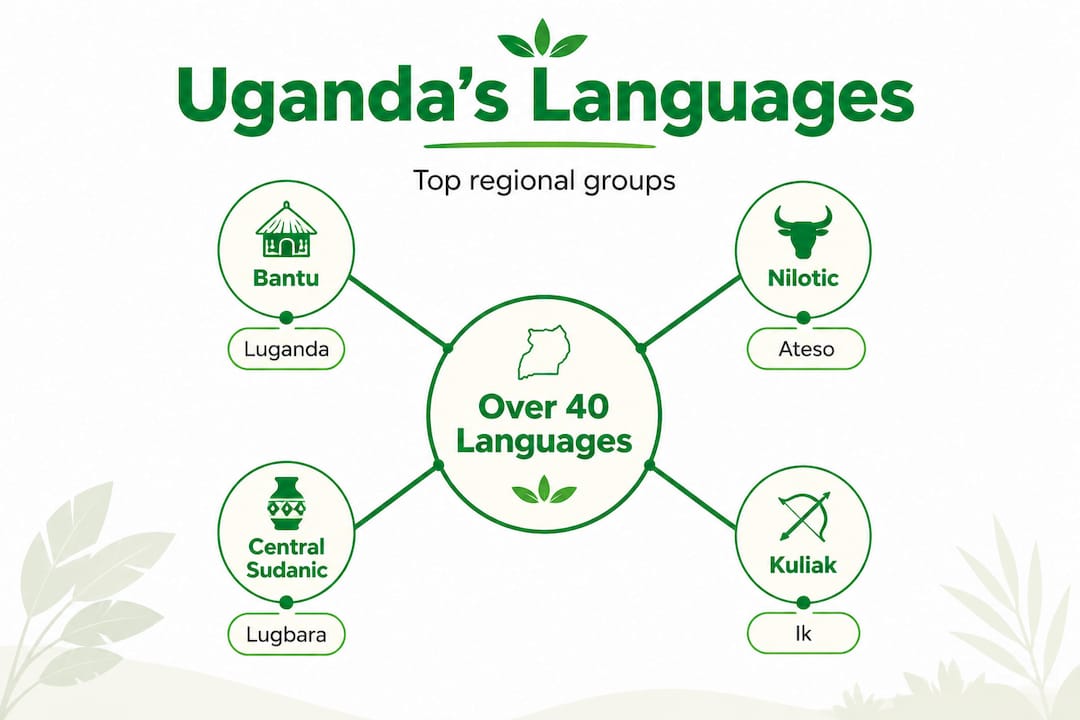
Once you move beyond the two official languages, Uganda’s true linguistic richness becomes apparent. The country is home to over 40 to 70 indigenous languages grouped into four main language families: Bantu, Nilotic, Central Sudanic, and Cushitic (also called Kuliak). Each family reflects a distinct historical migration, cultural tradition, and geographic region.
The four main language families:
- Bantu languages are the most widespread, spoken across central, southern, and western Uganda. Luganda, the language of the Baganda people, is the most widely spoken indigenous language in the country and serves as a lingua franca in Kampala and the central region. Other Bantu languages include Runyankole, Rukiga, Lusoga, and Rutooro.
- Nilotic languages cover the north and east. Acholi is spoken in the Acholi sub-region around Gulu, while Langi is common in Lira. In eastern Uganda, Ateso is the primary language of the Iteso people, one of the country’s largest ethnic groups.
- Central Sudanic languages are found in the northwest. Lugbara is spoken by the Lugbara people around Arua, and Alur is common near the border with the Democratic Republic of Congo.
- Cushitic/Kuliak languages are the least spoken, found among small communities in the northeast, including the Ik people of the Karamoja region.
Here is a regional breakdown to help you orient yourself:
| Region |
Dominant language(s) |
Language family |
| Central (Kampala, Wakiso) |
Luganda |
Bantu |
| Eastern (Mbale, Soroti) |
Ateso, Lugisu |
Nilotic, Bantu |
| Northern (Gulu, Lira) |
Acholi, Langi |
Nilotic |
| Western (Mbarara, Fort Portal) |
Runyankole, Rutooro |
Bantu |
| Northwestern (Arua) |
Lugbara, Alur |
Central Sudanic |
| Northeastern (Karamoja) |
Karamojong, Ik |
Nilotic, Kuliak |
Understanding which language is spoken in the region you are visiting adds a meaningful layer to your experience. If you are heading to western Uganda for
gorilla trekking in Bwindi, you will likely encounter Rukiga and Rufumbira speakers in the local communities around the park.
Languages along common travel corridors
| Common travel corridor |
Languages travelers are most likely to encounter |
Best approach |
| Entebbe–Kampala–Jinja |
English and Luganda are especially common in central Uganda. |
Use English confidently and try a Luganda greeting in informal settings. |
| Kampala–Murchison Falls |
English is reliable for tourism; local languages become more prominent outside Kampala. |
Follow your guide’s local-language cues during stops and community interactions. |
| Bwindi–Kisoro |
Rukiga and Rufumbira may be heard in communities around the gorilla-trekking region. |
English works for trekking logistics; a local greeting is a thoughtful gesture. |
| Gulu–Lira |
Acholi and Langi are widely associated with northern Uganda. |
Use English for services and ask your guide which greeting is appropriate locally. |
| Arua and northwestern Uganda |
Lugbara and Alur are among the important local languages in the region. |
Rely on English for tourism arrangements and guide-assisted translation for deeper conversations. |
Pro Tip: Before your trip, learn to say “Hello” and “Thank you” in the dominant language of your destination region. In Luganda, “Oli otya” means “How are you?” and “Webale” means “Thank you.” In Rukiga, used near Bwindi, “Agandi” is a common greeting. These small gestures carry enormous warmth.
How language is used in Ugandan daily life and travel settings
What language should travelers use in Uganda? Use English for airports, hotels, national parks, restaurants, bookings, and guided safaris. Use a local greeting to show respect in markets and community visits. Swahili is useful as a bonus, especially in some border-trade, police, military, and regional business contexts, but it is not essential for most safari itineraries. In rural settings, your guide can help translate when needed.
Understanding Uganda’s language map is one thing. Knowing how language actually functions when you are on the ground is another. The way Ugandans switch between languages depending on context is fluid, natural, and fascinating to observe.
What language should travelers use in Uganda? Use English for airports, hotels, national parks, restaurants, bookings, and guided
Uganda safaris. Use a local greeting to show respect in markets and community visits. Swahili is useful as a bonus, especially in some border-trade, police, military, and regional business contexts, but it is not essential for most safari itineraries. In rural settings, your guide can help translate when needed.
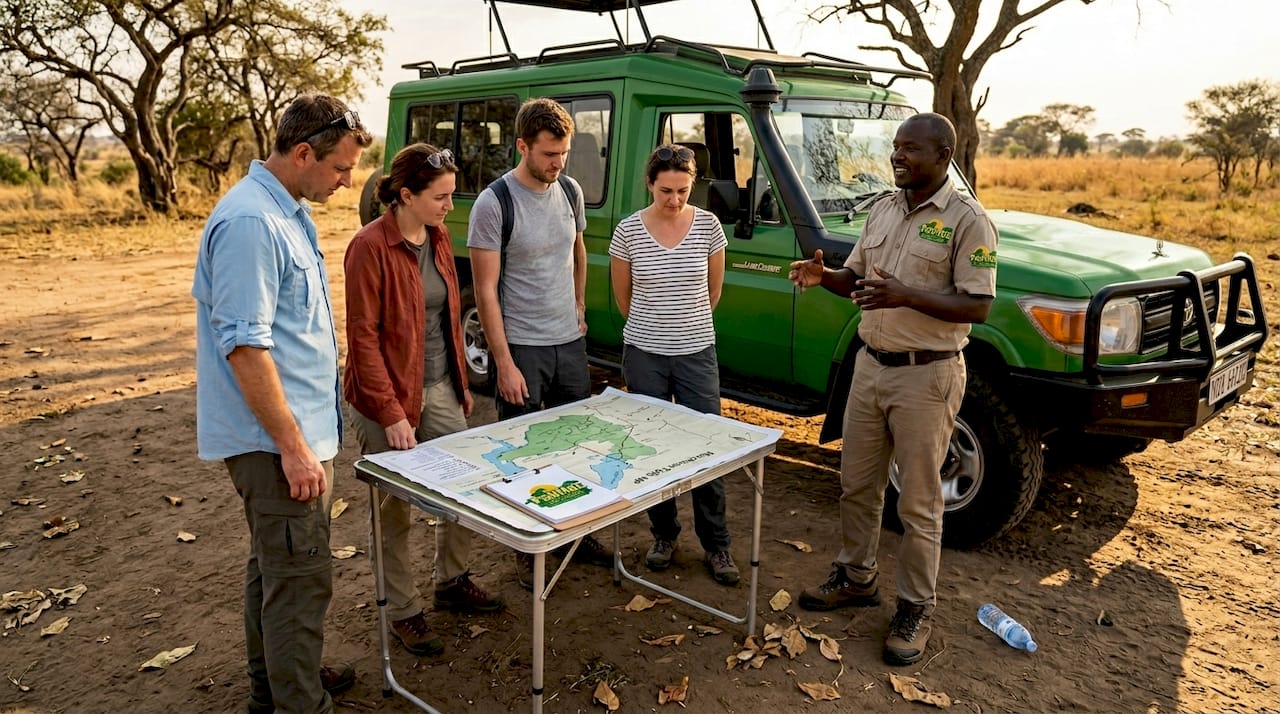
In Kampala and other urban centers, English is the default for business, education, and formal interactions. Hotel staff, tour operators, and government officials will address you in clear, confident English. The safari industry is particularly well equipped for international visitors, with guides and lodge managers trained to communicate in English and sometimes French, German, or Mandarin for specific markets.
Here is how language typically plays out across different travel settings:
- Safari lodges and national parks: English is standard. Your guide, ranger, and lodge staff will communicate fluently. Expect detailed wildlife briefings, safety instructions, and cultural context all delivered in English.
- Urban markets and shopping areas: A mix of English, Luganda, and Swahili. Vendors may greet you in Luganda first, then switch to English when they realize you are a visitor.
- Rural communities and village walks: Local languages dominate. Your guide or a community liaison will translate for you. These interactions are often the most memorable of any Uganda trip.
- Schools and educational settings: The mother tongue is used in Primary 1 through Primary 3, after which English becomes the language of instruction. This policy means older children and adults generally have functional English, while very young children may not.
- Religious settings: Churches and mosques often conduct services in local languages, though larger congregations in cities may offer English services as well.
Understanding
safari language terminology before your trip also helps you follow briefings more easily, especially during
Uganda gorilla trekking or
chimpanzee tracking, where guides use specific terms for group behavior, vegetation, and trail conditions. The
role of safari guides in Uganda extends well beyond wildlife identification. They serve as cultural interpreters, community connectors, and informal language bridges throughout your journey.
Pro Tip: Download a basic Luganda or Swahili phrasebook app before you travel. Even attempting a few words in the local language signals respect and genuine curiosity. Ugandans respond warmly to visitors who try, regardless of pronunciation.
Uganda’s language landscape did not develop in a vacuum. It carries the weight of colonial history, post-independence politics, and ongoing debates about cultural identity and national unity. Understanding this context helps travelers appreciate why language is such a meaningful topic for Ugandans.
English became dominant through British colonial rule, which lasted from the late 19th century until 1962. The colonial administration imposed English as the language of education, law, and governance, effectively sidelining indigenous languages in formal settings. That legacy persists today, and efforts to promote local languages versus English dominance remain a live debate in Ugandan education and public policy circles.
Key points in the ongoing language debate:
- English as a gatekeeper: Proficiency in English largely determines access to higher education, professional employment, and government positions. This creates inequality between urban and rural communities.
- Swahili’s complex reception: While Swahili is promoted as a pan-African and East African identity language, many Ugandans historically associated it with the military under Idi Amin’s regime. Acceptance has grown significantly in recent decades, but it is still less embedded in daily life than in Kenya or Tanzania.
- Indigenous language preservation: Languages like Lusoga, Lugwere, and several smaller Nilotic tongues face pressure from urbanization and the dominance of English in education. Linguists and cultural organizations are actively working to document and revitalize these languages.
- Cultural identity: For many Ugandans, their mother tongue is inseparable from their ethnic identity, oral traditions, music, and ceremonies. Losing a language means losing a piece of that heritage.
A
comparison with Kenya’s language approach reveals interesting contrasts. Kenya has embraced Swahili far more deeply as a national identity language, while Uganda’s linguistic identity remains more fragmented and regionally diverse. Neither approach is superior; they simply reflect different historical and political paths.
“Language in Uganda is not just a communication tool. It is a living archive of ethnic identity, ancestral knowledge, and community belonging, which is why travelers who engage with local languages often report the most transformative experiences.”
Travel tips: Making the most of Uganda’s linguistic landscape
Pronunciation tip: Say unfamiliar words slowly, listen first, and let the person you are speaking with guide the rhythm. For example, “Oli otya?” can be approached in short parts: “o-li o-tya.” You do not need perfect pronunciation; a warm tone, patience, and willingness to learn matter more than attempting to sound fluent.
| Where you are traveling |
Useful word or phrase |
When to use it |
| Kampala and central Uganda |
Oli otya? — “How are you?” |
A friendly Luganda greeting in informal conversations. |
| Kampala and central Uganda |
Webale — “Thank you” |
After receiving help, buying something, or sharing a meal. |
| Bwindi and western Uganda |
Agandi — a common Rukiga greeting |
Use respectfully when meeting community members near Bwindi. |
| Across many travel settings |
Jambo — “Hello” |
A familiar Swahili greeting that may be understood, though English and local languages are often more common in daily conversation. |
| Across many travel settings |
Asante — “Thank you” |
A useful Swahili thank-you, particularly as a polite extra phrase alongside English. |
| Northern, northwestern, and border areas |
Ask your guide for the locally appropriate greeting. |
Language use can change significantly between communities, so local guidance is the most respectful choice. |
Now that you understand the structure and history of Uganda’s languages, here are practical steps to help you communicate better and connect more authentically during your visit.
- Learn basic greetings in Luganda and Swahili. “Jambo” (Swahili for hello) and “Oli otya” (Luganda for how are you) will open conversations instantly. “Asante” (Swahili for thank you) is universally understood and appreciated.
- Ask your guide to teach you phrases along the way. Most Ugandan guides love sharing their language and will happily teach you words for animals, landscapes, and foods during game drives or gorilla treks.
- Pay attention to non-verbal communication. A nod, a two-handed handshake, or removing shoes before entering a home are all part of the communication culture. Language and gesture work together in Ugandan social settings.
- Read signs and materials in English. Nearly all written materials you encounter, from park entrance signs to restaurant menus, will be in English. You will not struggle with written communication anywhere in the tourism circuit.
- Be patient in rural settings. In villages near Bwindi or in communities around Murchison Falls, English may be limited. Smile, use gestures, and rely on your guide. These moments of imperfect communication often become the most cherished travel memories.
- Use language respectfully. Avoid mimicking accents or making jokes about pronunciation. Ugandans are proud of their linguistic heritage, and a respectful attitude goes a long way.
Essential traveler phrases by region
| Where you are traveling |
Useful word or phrase |
When to use it |
| Kampala and central Uganda |
Oli otya? — “How are you?” |
A friendly Luganda greeting in informal conversations. |
| Kampala and central Uganda |
Webale — “Thank you” |
After receiving help, buying something, or sharing a meal. |
| Bwindi and western Uganda |
Agandi — a common Rukiga greeting |
Use respectfully when meeting community members near Bwindi. |
| Across many travel settings |
Jambo — “Hello” |
A familiar Swahili greeting that may be understood, though English and local languages are often more common in daily conversation. |
| Across many travel settings |
Asante — “Thank you” |
A useful Swahili thank-you, particularly as a polite extra phrase alongside English. |
| Northern, northwestern, and border areas |
Ask your guide for the locally appropriate greeting. |
Language use can change significantly between communities, so local guidance is the most respectful choice. |
Pronunciation tip: Say unfamiliar words slowly, listen first, and let the person you are speaking with guide the rhythm. For example, “Oli otya?” can be approached in short parts: “o-li o-tya.” You do not need perfect pronunciation; a warm tone, patience, and willingness to learn matter more than attempting to sound fluent.
A basic grasp of local greetings and key phrases genuinely transforms how communities receive you as a visitor. It signals that you are not just passing through but are genuinely interested in the people and their world.
Thinking about planning your own adventure? Browse our Uganda safari packages and pricing to see how we blend wildlife tracking with authentic cultural encounters. For a deeper overview of planning your visit, the
Uganda safari guide covers everything from park logistics to cultural etiquette in one place.
Pro Tip: Write down five to ten key phrases on a small card before you travel. Pull it out during meals or community visits. Ugandans will laugh with you (not at you) and appreciate the effort enormously.
Why navigating Uganda’s languages is your gateway to authentic travel
Here is something most travel articles will not tell you: language is not a logistics problem to solve before you arrive. It is the most powerful tool you have for experiencing Uganda beyond the surface level.
Every traveler who attempts a Luganda greeting at a roadside market or a Rukiga “Agandi” near a Bwindi village will tell you the same thing. People light up. Conversations start. Doors open that would otherwise stay closed to visitors who rely entirely on English. This is not a small thing. It is the difference between watching Uganda from behind glass and actually stepping into it.
Uganda safaris are extraordinary on their own terms. Watching a habituated mountain gorilla family move through dense forest, or seeing a pride of lions at dusk in Queen Elizabeth National Park, needs no translation. But the conversations you have with your guide about what that gorilla family’s behavior means, the story a village elder shares about living alongside wildlife, the laughter over a mispronounced Luganda word at a community lunch, these are the moments that stay with you for decades.
The
advantages of guided safaris in Uganda go far beyond knowing where the animals are. A skilled Ugandan guide translates not just language but culture, history, and ecological knowledge in real time. That combination of linguistic and environmental fluency is something no app or phrasebook can replicate.
Travelers who invest even a small amount of effort in Uganda’s languages consistently report richer, more personal experiences. It is not about fluency. It is about curiosity, respect, and a willingness to meet people where they are.
Discover Uganda’s languages and wildlife with expert guides
Uganda’s linguistic diversity is one of the many layers that make this country so extraordinary to explore. From the Bantu heartlands of central Uganda to the Nilotic communities of the north, every region offers a distinct cultural and linguistic identity waiting to be discovered.
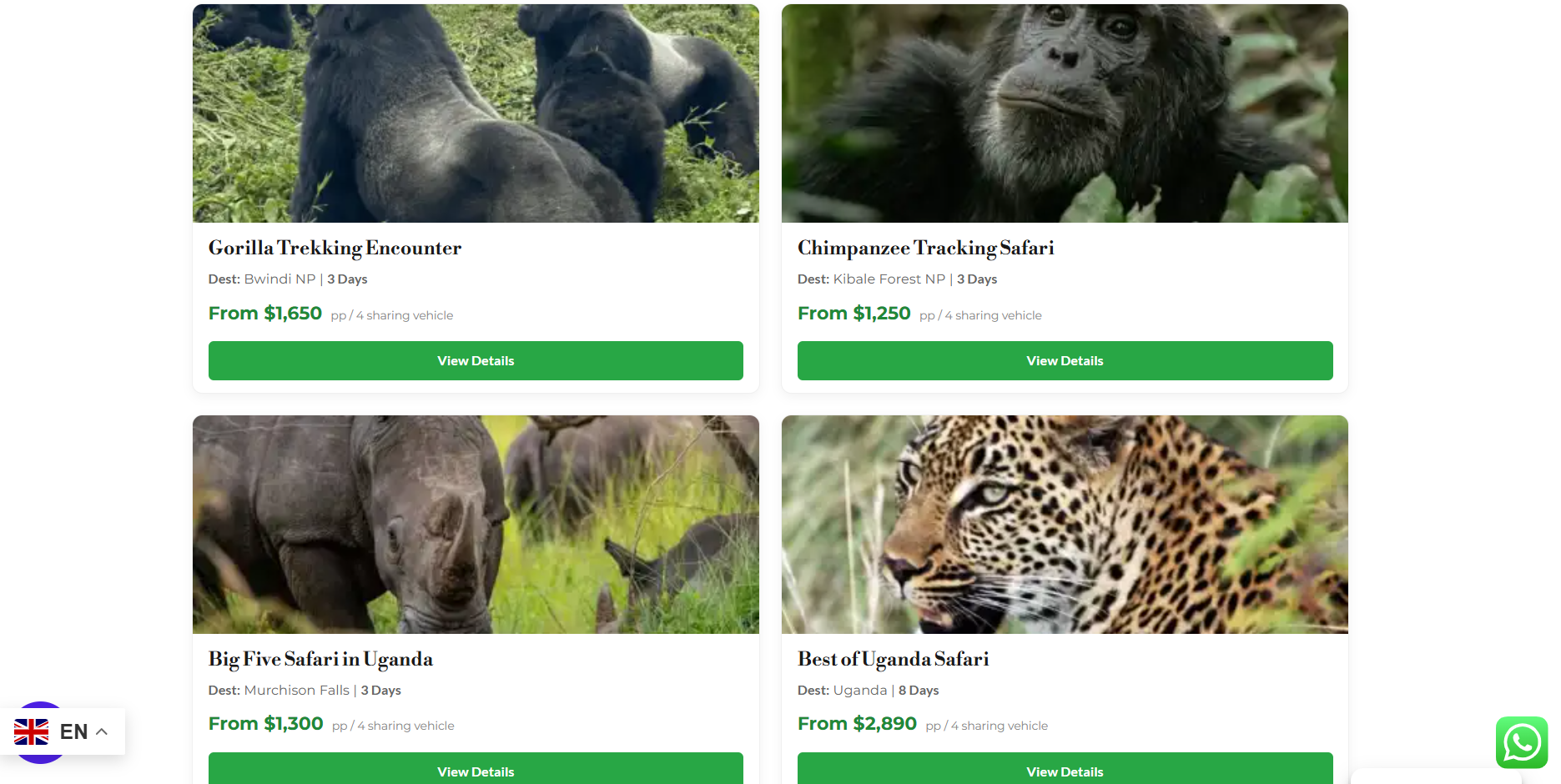
At PawMac Safaris, our Ugandan-led team brings deep local knowledge to every journey, including the cultural and linguistic context that makes each destination come alive. Whether you are trekking mountain gorillas in Bwindi, tracking chimpanzees in Kibale, or cruising the Kazinga Channel, our guides bridge language and culture seamlessly.
Ready for the journey of a lifetime? Explore our
Uganda Safari tours to find a tailored package that connects you with Uganda’s wildlife, communities, and living languages in the most authentic way possible.
Frequently asked questions
What are the official languages of Uganda?
Uganda’s official languages are English and Swahili, as established by the 1995 Constitution, Article 6, with English serving as the primary language of government and education.
How many languages are spoken in Uganda?
Uganda is home to over 40 to 70 indigenous languages grouped into four main language families: Bantu, Nilotic, Central Sudanic, and Cushitic.
Will I get by with just English when visiting Uganda?
English is widely spoken in cities and throughout the tourism and
Uganda safari industry, but learning a few local greetings will significantly enrich your interactions in rural and community settings.
What language do safari guides in Uganda speak?
Safari guides in Uganda typically speak fluent English and often have working knowledge of Luganda, Swahili, and the local language of their home region, making them excellent cultural and linguistic bridges for international travelers.
Is Swahili commonly spoken in Uganda?
Swahili is an official language used in some business and government contexts, but it is considerably less embedded in everyday life than in neighboring Kenya or Tanzania, where it functions as a true national language.
Recommended


