


- 66 Views
- 10 Min Read
- (0) Comment
TL;DR:
- Bwindi houses nearly half of the world’s critically endangered mountain gorillas.
- The forest’s rich biodiversity makes it a UNESCO World Heritage Site and a global conservation success.
- Gorilla trekking in Bwindi offers affordable permits, diverse ecosystems, and extensive wildlife encounters.
Bwindi Impenetrable Forest sits in southwestern Uganda like a living vault of biological history, drawing travelers from every corner of the globe. Most people associate it with mountain gorillas, and for good reason: nearly half the world’s endangered mountain gorillas call this ancient rainforest home. But Bwindi’s fame stretches far beyond a single species. This article walks you through the gorilla trekking experience, the forest’s staggering biodiversity, practical logistics, and why Bwindi consistently ranks as one of the planet’s most extraordinary wildlife destinations.
Table of Contents
- Bwindi’s global gorilla significance
- Bwindi’s extraordinary biodiversity
- Gorilla trekking: Experience, logistics, and impact
- Bwindi vs Rwanda: Trekking, value, and accessibility
- Why Bwindi stands out: Lessons and travel wisdom
- Plan your Uganda safari with trusted experts
- Frequently asked questions
Key Takeaways
| Point | Details |
|---|---|
| Global gorilla haven | Bwindi hosts nearly half the world’s mountain gorillas and offers unmatched trekking experiences. |
| UNESCO biodiversity | The park is a UNESCO World Heritage Site with hundreds of mammals, birds, and plants for wildlife enthusiasts. |
| Affordable access | Permit costs in Bwindi are much lower than Rwanda’s, making world-class trekking accessible to more travelers. |
| Conservation impact | Permit revenue directly supports gorilla conservation, local communities, and anti-poaching initiatives. |
| Rugged adventure | Bwindi’s challenging terrain and multi-species rainforest provide authentic, memorable experiences beyond gorillas. |
Bwindi’s global gorilla significance
Few wildlife destinations carry the kind of global weight that Bwindi does. Mountain gorillas (Gorilla beringei beringei) are critically endangered, and Bwindi shelters approximately 400 to 459 individuals across its mist-covered slopes. That figure represents a remarkable conservation achievement, one built over decades of international effort, community buy-in, and strict management.
What makes Bwindi particularly unique is that mountain gorillas cannot survive in captivity. You will not find them in any zoo on earth. Seeing them means coming here, or to Mgahinga Gorilla National Park just south of Bwindi, or crossing into Rwanda or the Democratic Republic of Congo. For many travelers, Bwindi is the first choice, and the numbers bear that out.
| Key Gorilla Data | Details |
|---|---|
| Total population in Bwindi | Approximately 400 to 459 individuals |
| Habituated gorilla families | 19 families accessible to visitors |
| Daily permit limit | 176 to 194 permits across four sectors |
| Trek success rate | 99% |
| Permit cost (foreign non-residents) | $800 USD |
The four trekking sectors, Buhoma, Rushaga, Ruhija, and Nkuringo, each offer distinct terrain and habituated gorilla families. Buhoma is the oldest and most accessible. Rushaga holds the highest number of habituated families. Ruhija sits at a higher elevation and attracts serious birders alongside gorilla seekers. Nkuringo, perched on a ridge with sweeping views, delivers one of the most dramatic approaches of any sector.
Understanding gorilla permit costs before you travel saves both money and frustration. Permits are issued by the Uganda Wildlife Authority and must be secured in advance, especially for peak dry season months of June through August and December through February.
- Permits cost $800 USD per person for foreign non-residents
- East African citizens pay significantly less
- Only eight visitors are allowed with each gorilla family at a time
- Trek duration ranges from one to eight hours depending on gorilla location
- A ranger-led briefing precedes every trek
Pro Tip: For the best gorilla trekking availability, start booking gorilla trekking at least three to six months before your intended travel date, especially if you are targeting the dry season.
Permit revenue flows directly into conservation programs and local community projects. The trekking model essentially transforms gorillas from a poaching target into a living economic asset, making their protection a community priority rather than a government imposition. That shift in incentive is arguably one of the most effective conservation strategies Africa has ever produced. If you want the complete gorilla trekking guide before booking, it covers every practical detail from packing lists to physical preparation.
Bwindi’s extraordinary biodiversity
Gorillas are the headline, but Bwindi’s ecological complexity is what earns it UNESCO World Heritage Site status. The forest is one of the oldest and most biologically diverse in Africa, believed to have survived the ice ages as a refuge for species that disappeared elsewhere on the continent.
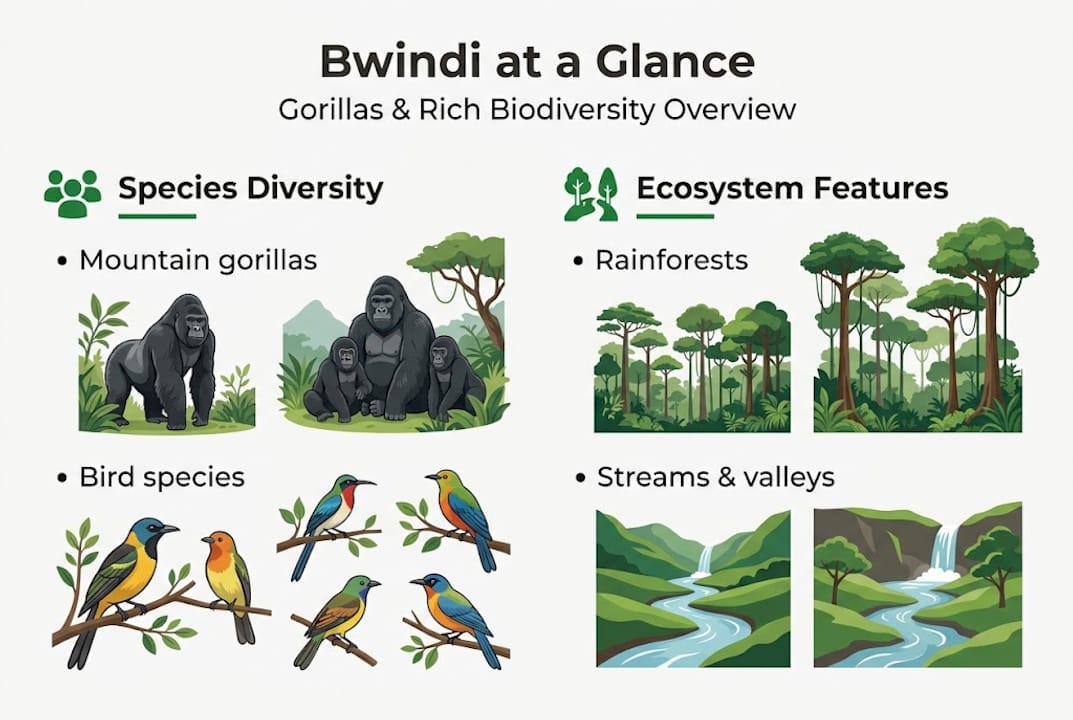
Bwindi hosts over 1,000 flowering plants, 120 mammal species, 350 bird species, and 426 chimpanzees within its 331 square kilometers. For context, many national parks ten times its size don’t come close to those numbers. The forest layers, from the dense canopy down to the mossy forest floor, create micro-habitats that support wildly different communities of life.
“Bwindi is one of Africa’s most important ecosystems, not simply because of gorillas, but because its intact rainforest supports life that cannot exist anywhere else.” — Uganda National Parks
Birders will find Bwindi especially rewarding. The park holds 23 Albertine Rift endemic species, a region globally recognized for its concentration of unique wildlife. Look for the African green broadbill, Shelley’s crimsonwing, and the handsome francolin. These species don’t appear on typical safari checklists, and finding them in Bwindi’s dense canopy is an experience serious birders plan for years.
Plan Your Uganda Safari with Local Experts
 WhatsApp Us
| Species Category | Count in Bwindi |
|---|---|
| Flowering plant species | Over 1,000 |
| Mammal species | 120 |
| Bird species | 350 |
| Chimpanzees | 426 |
| Butterfly species | Over 200 |
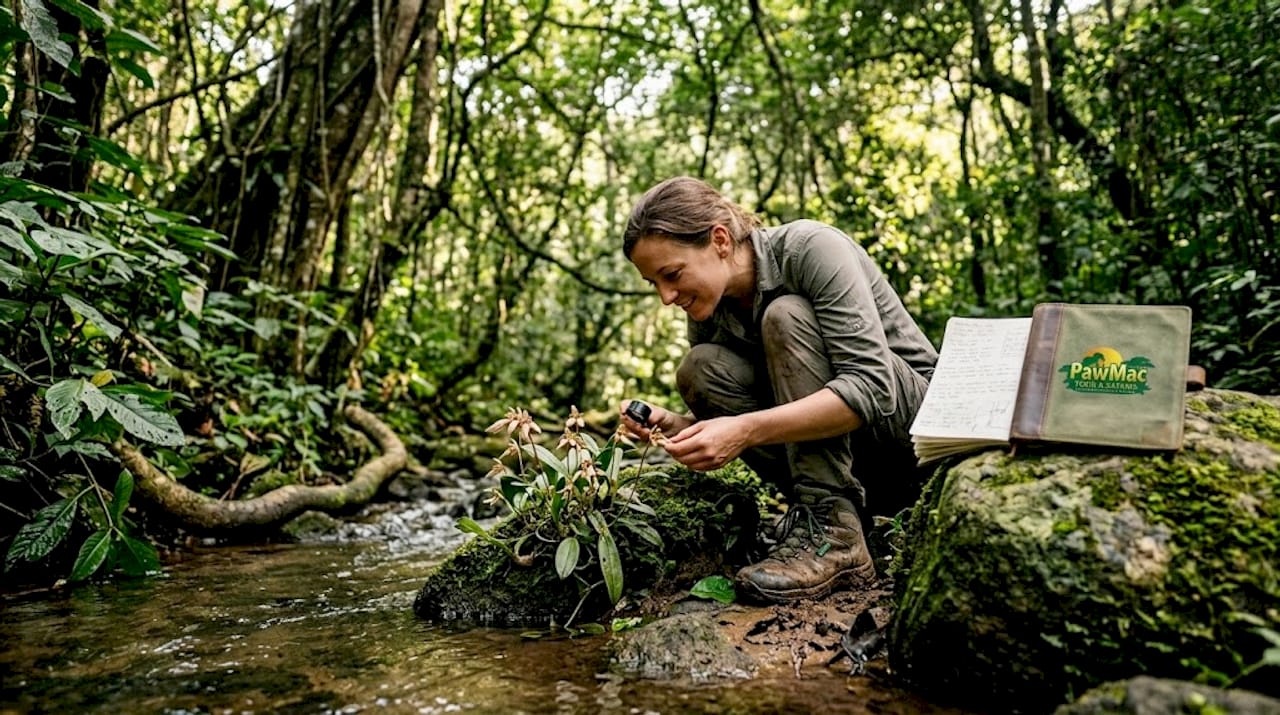
Beyond the numbers, Bwindi’s terrain is itself a spectacle. Deep valleys, rushing streams, and ancient fig trees create a setting that rewards slow, attentive exploration. The Uganda safari guide outlines how to combine Bwindi with other ecosystems like Queen Elizabeth National Park or Murchison Falls for a fuller picture of Uganda’s wildlife wealth.
For those wondering where to see gorillas in the region, Bwindi offers the widest selection of habituated families and the most diverse surrounding ecosystem of any site in East or Central Africa.
Gorilla trekking: Experience, logistics, and impact
Here is what a typical gorilla trek in Bwindi actually looks like. Treks begin early in the morning, usually between 7:00 a.m. and 8:00 a.m. Rangers lead groups through the forest, tracking the previous day’s GPS coordinates and fresh signs like feeding debris and nesting sites. When the group reaches the gorillas, you have exactly one hour with the family.
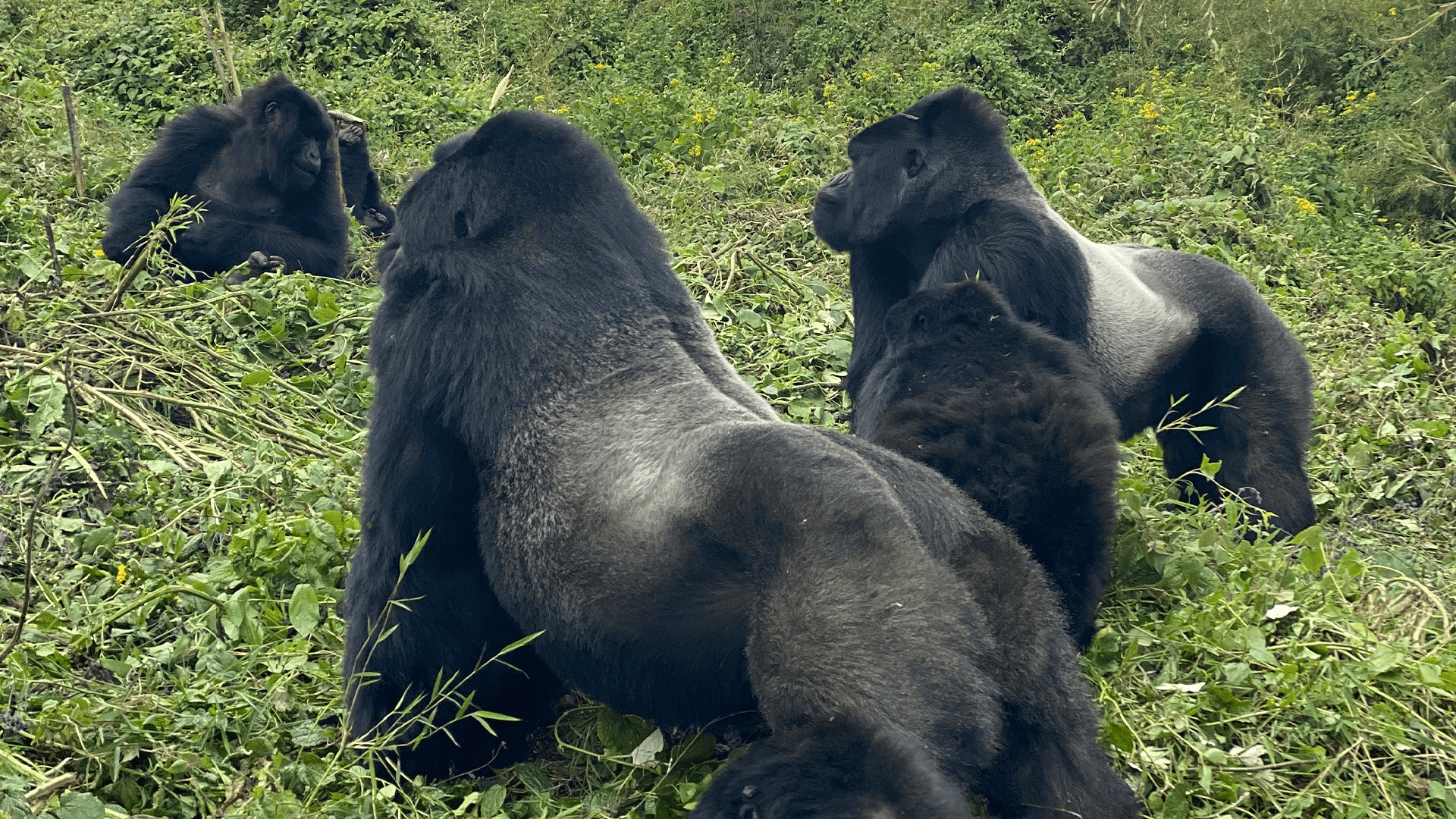
That hour is genuinely unforgettable. Silverbacks can weigh over 220 kilograms (about 485 pounds). Watching them move, feed, and interact with younger members of their family just meters away is a kind of encounter that resets your sense of what wildlife means.
- Arrive at the sector briefing point by 7:30 a.m.
- Receive a safety and conduct briefing from Uganda Wildlife Authority rangers
- Trek into the forest, guided by a lead ranger and armed escorts
- Locate the habituated gorilla family (trackers may radio ahead)
- Spend one hour with the family at a respectful minimum distance of 7 meters
- Return to the trailhead for a certificate presentation
Trekking logistics in Bwindi vary by sector, so matching the right sector to your fitness level matters. Nkuringo involves steep descents. Buhoma offers a gentler introduction. Rushaga is ideal for habituation experience treks, which run for four hours instead of one.
| Sector | Habituated Families | Terrain Difficulty | Best For |
|---|---|---|---|
| Buhoma | 4 | Moderate | First-time trekkers |
| Rushaga | 8 | Moderate to steep | Families, habituation |
| Ruhija | 4 | Steep | Birders, experienced hikers |
| Nkuringo | 3 | Very steep | Adventure seekers |
Permit sales reached 41,468 in 2025, a sign of rising global demand. Revenue from those permits directly funds anti-poaching operations, ranger salaries, and community conservation programs in surrounding villages.
Pro Tip: Start preparing for gorilla trekking three to six months in advance. Book permits early, hire a local porter (they know the terrain and the extra income supports local families), and train for uphill walking if you’re not regularly active.
Bwindi vs Rwanda: Trekking, value, and accessibility
The choice between Uganda’s Bwindi and Rwanda’s Volcanoes National Park comes up for most serious gorilla trekking planners. Both are excellent. But the differences matter depending on your priorities.
The most obvious difference is permit cost. Uganda permits are $800 compared to Rwanda’s $1,500, a $700 saving per person that adds up quickly for couples or families. Rwanda has invested heavily in luxury tourism infrastructure, and the approach from Kigali to Volcanoes National Park is fast and comfortable. Bwindi takes more effort to reach, but that effort filters out casual tourists and adds to the sense of genuine expedition.
| Factor | Bwindi, Uganda | Volcanoes, Rwanda |
|---|---|---|
| Permit cost | $800 USD | $1,500 USD |
| Terrain | Rugged, forested | Volcanic, open slopes |
| Trek difficulty | Moderate to very steep | Moderate |
| Habituated families | 19 | 12 |
| Broader wildlife | Exceptional | Limited |
| Nearest airport | Entebbe (7 to 9 hours) | Kigali (2 to 3 hours) |
Bwindi wins clearly on wildlife diversity. Rwanda’s Volcanoes National Park is almost entirely focused on gorillas. Bwindi surrounds you with chimpanzees, hundreds of bird species, rare mammals, and dense rainforest ecosystem. For travelers who want more than a single species encounter, Bwindi offers higher value on almost every metric.
- More habituated gorilla families in Bwindi
- Lower permit cost frees budget for extended Uganda safari
- More diverse ecosystems surrounding the park
- Habituation experience treks available in Bwindi (not widely offered in Rwanda)
Pro Tip: If budget is a key factor, Bwindi delivers far more wildlife value per dollar spent. Pair gorilla trekking with a game drive in Queen Elizabeth National Park and you have one of Africa’s finest combination safaris.
For a detailed breakdown, the Uganda vs Rwanda trekking comparison covers permit availability, logistics, and experience quality side by side. And if you’re ready to look at actual tours, Uganda gorilla trekking tours offer a range of options for different budgets and timeframes.
Why Bwindi stands out: Lessons and travel wisdom
Here is something most travel guides won’t tell you: the difficulty of getting to Bwindi is part of what makes it extraordinary. The long drive through rolling tea fields and remote villages isn’t an inconvenience; it’s a transition. By the time you reach the forest edge, you feel the distance from ordinary life.
There is also a conservation story here that tends to get buried under the excitement of the trek itself. Gorilla populations grew from under 300 individuals in the 1980s to over 1,000 today. Many of the rangers and trackers guiding you through the forest were once subsistence hunters. The same knowledge that once helped them locate animals for trapping now protects those animals from everyone else. That transformation, from threat to guardian, is one of conservation’s rare genuine success stories.
Most travelers also underestimate how much the surrounding ecosystem enriches the trip. Reading the Uganda travel guide before you arrive reveals how Bwindi fits into a broader country of remarkable wildlife density. Gorillas are the centerpiece, but the forest holds layers of life that reward every extra hour you spend inside it.
Plan your Uganda safari with trusted experts
Planning a gorilla trek in Bwindi requires local knowledge, reliable permit access, and on-the-ground experience that makes the difference between a good trip and an exceptional one. PawMac Safaris specializes in exactly that.

Whether you’re looking for a focused gorilla trekking experience or a full Uganda circuit through multiple ecosystems, the team at PawMac Safaris designs every journey around your timeline, fitness level, and interests. Explore the full range of best Uganda wildlife tours or browse tailored gorilla trekking experiences built around Bwindi’s trekking sectors. For a wider look at what Uganda offers, the Uganda safari tours page brings the entire country into focus. Reach out and let the experts help you make it happen.
Frequently asked questions
Why is Bwindi Impenetrable National Park so famous for gorilla trekking?
Bwindi is globally recognized because it houses nearly half of the world’s mountain gorillas in a UNESCO-listed rainforest, with a 99% trek success rate that makes encounters almost guaranteed for permitted visitors.
How much does a gorilla trekking permit cost in Bwindi?
A gorilla trekking permit in Bwindi costs $800 USD for foreign non-residents in 2026, significantly more affordable than Rwanda’s $1,500 permit while offering a comparable and often richer trekking experience.
What other wildlife can you see in Bwindi besides gorillas?
Bwindi supports 120 mammal species, 350 bird species, 426 chimpanzees, and over 1,000 flowering plant species, making it one of Africa’s most biodiverse rainforest ecosystems far beyond any single-species destination.
What makes Bwindi’s trekking experience different from Rwanda’s?
Bwindi offers more affordable permits, 19 habituated gorilla families versus Rwanda’s 12, rugged rainforest terrain with greater biodiversity, and habituation experience options that Rwanda’s terrain and infrastructure don’t match in the same way.
Recommended
- Gorilla Trekking Uganda 2026 – Permits, Prices & Best Safaris
- Gorilla Trekking in Uganda: Cost, Permits & Tours 2026
- Gorilla Trekking Uganda 2026: $800 Permit + Full Costs
- Uganda primate tracking: gorillas, chimps & golden monkeys


