


- 44 Views
- 11 Min Read
- (0) Comment
TL;DR:
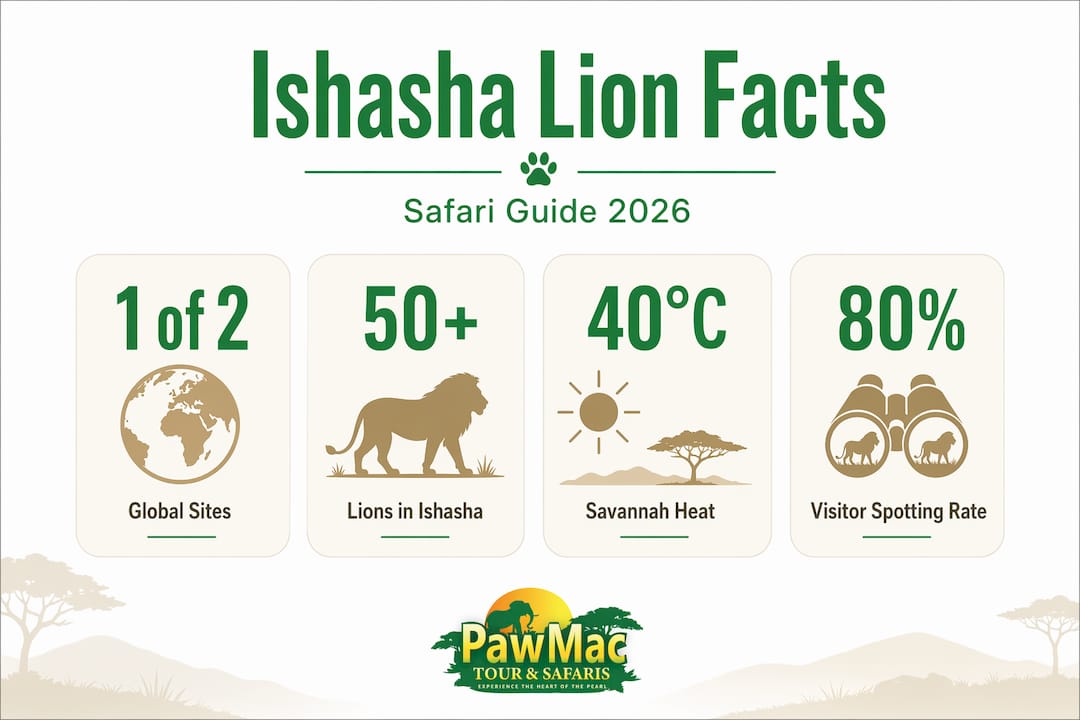
- The tree climbing lions of Ishasha in Uganda exhibit a unique learned behavior driven by heat, insects, and hunting advantages. Their population has declined to about 40 individuals, highlighting the urgent need for conservation efforts. Visiting during the dry season and supporting ethical tourism helps protect these remarkable animals and their environment.
Few wildlife encounters stop travelers in their tracks quite like spotting a lion stretched across the branches of a fig tree, silhouetted against the golden light of a Ugandan afternoon. The tree climbing lions Ishasha is famous for are not a myth or a trained spectacle. They are wild animals displaying one of the most unusual behavioral adaptations in the entire lion world. Found in the remote Ishasha sector of Queen Elizabeth National Park, these lions have fascinated researchers and safari-goers for decades. This guide covers their behavior, ecology, conservation status, and exactly how to plan your sighting in 2026.
Table of Contents
- Key takeaways
- Where tree climbing lions in Ishasha actually live
- Why Ishasha lions climb trees: behavior and science
- Conservation status and why it matters for your safari
- Planning your Ishasha lion sightings in 2026
- My perspective: what Ishasha teaches you about adaptability
- See the Ishasha lions with Pawmacsafaris in 2026
- FAQ
Key takeaways
| Point | Details |
|---|---|
| Rare global phenomenon | Ishasha is one of only two places on Earth where lions regularly climb trees. |
| Behavior is learned, not genetic | Cubs learn to climb from older pride members, making this a cultural tradition passed through generations. |
| Population under pressure | Queen Elizabeth’s lion population has declined to about 40 individuals, demanding urgent conservation support. |
| Best viewing season | Visit during the dry seasons (June to September or December to February) for the clearest sightings. |
| Book ahead in 2026 | Prepay park fees through a licensed operator to avoid unreliable gate payment systems in Ishasha. |
Where tree climbing lions in Ishasha actually live
The Ishasha sector sits in the far southwestern corner of Queen Elizabeth National Park, pressed against the border of the Democratic Republic of Congo. It is remote, sparsely visited compared to the park’s northern sectors, and that relative solitude is part of what makes it special. The terrain is not dramatic in the way the Rwenzori Mountains are. Instead, you get open savannah grassland, scattered acacia woodlands, and wide, flat plains that seem to stretch without interruption.
What sets Ishasha apart from most lion habitat in Africa are the trees. Specifically, the massive fig trees and broad-limbed acacias that grow throughout the sector. These are not the slender, scalable branches you would associate with a leopard’s larder. They are wide, sturdy structures with thick horizontal branches that sit low enough for a lion to heave itself onto with some effort.
Here is what defines the Ishasha environment and why it encourages climbing behavior:
- Low, broad branch architecture on fig and acacia trees gives lions a stable resting platform.
- Open savannah with few shaded ground spots means elevated canopy becomes the most comfortable cool zone during midday heat.
- Rich prey base including Uganda kob and other medium-sized antelopes shapes pride structure and movement patterns across this terrain.
- Smaller, tighter prides rather than the sprawling social groups common on the open Serengeti plains, which makes coordinated tree use more consistent within each family unit.
- Insect pressure on the ground, including tsetse flies and biting insects, makes elevated perches significantly more comfortable for resting lions.
Elsewhere in Africa, lions stay firmly grounded. The same species in Botswana’s Okavango Delta or Zambia’s Luangwa Valley almost never climbs. The behavior is not about the lions themselves being fundamentally different. It is about this specific environment selecting for a behavior that works.
Why Ishasha lions climb trees: behavior and science
Lions are not natural climbers. Their bodies are built for speed and power across flat ground, not the grip and agility that leopards display instinctively. So what drives these lions up into the canopy when the rest of their species stays below?
The science points to three overlapping pressures. First, heat avoidance. The Ishasha savannah gets intensely hot during the midday hours, and the ground radiates that heat back upward. A lion lying in a tree benefits from air circulation on all sides, dropping its body temperature without any effort. Second, insect deterrence. Ground-level insects, particularly biting flies, are far less prevalent in elevated branches where wind exposure increases. Third, the trees offer an elevated vantage point for monitoring approaching prey or rival predators without requiring the lion to expend energy moving around.
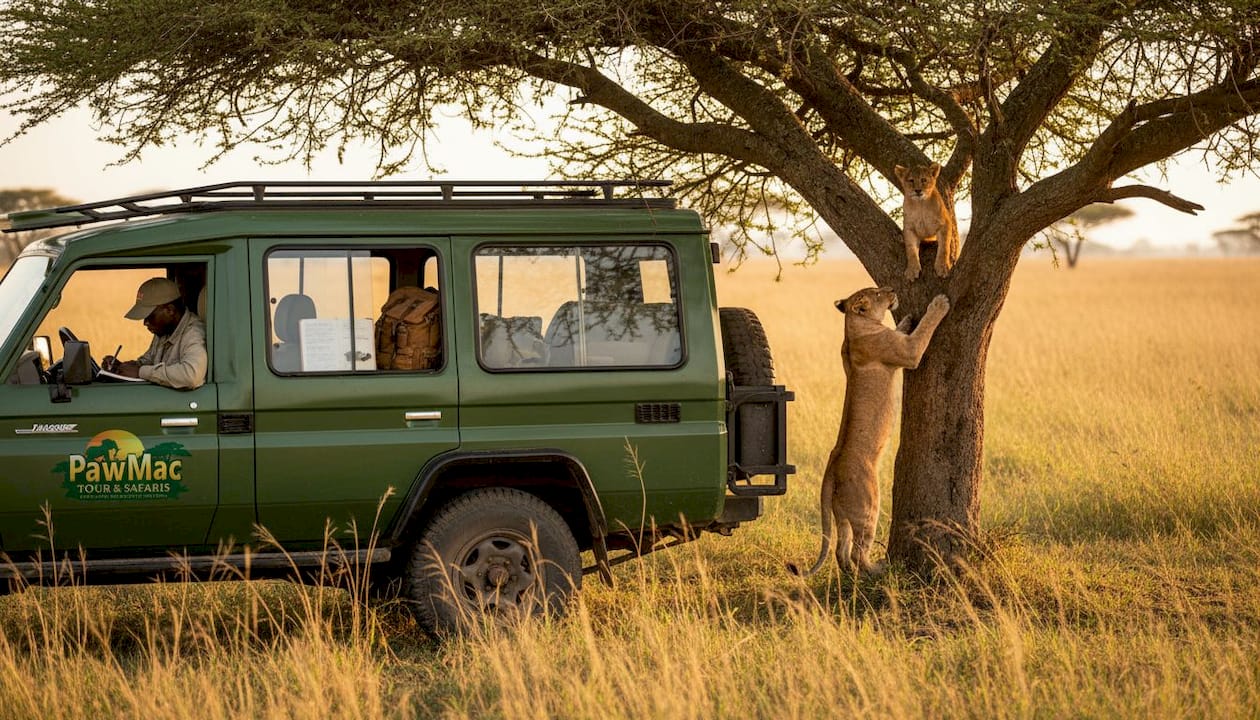
The most striking fact, though, is that tree climbing is a learned behavior passed from older pride members to cubs through observation and social imitation. It is not encoded genetically. A lion cub born in Ishasha learns to climb because it watches its mother do it. This makes tree climbing a genuine cultural tradition, one of the rare documented examples of animal culture transmission outside of primates and cetaceans.
Pro Tip: If you spot a pride with young cubs near tree bases, watch patiently. Cubs often attempt to follow adults up into the branches and their clumsy, determined climbing attempts are among the most endearing scenes in African wildlife.
Plan Your Uganda Safari with Local Experts
 WhatsApp Us
Despite this cultural adaptation, the physical effort involved is considerable. Lions are less equipped for climbing compared to leopards, whose retractile claws and lightweight frames make vertical surfaces routine. Ishasha lions manage by targeting specific trees with gradual inclines or angled trunks that reduce the vertical challenge. They clamber rather than scale. Getting down often looks awkward, even anxious, with lions sometimes backing down tail-first or leaping from lower branches.
Common myths worth addressing directly: these lions are not climbing to hunt from above, and they are not doing it for territorial display. The behavior is primarily about comfort and efficiency. Once you understand that, watching a 400-pound lion drag itself onto a branch 15 feet off the ground becomes even more impressive.
Conservation status and why it matters for your safari
The Ishasha lion story carries a shadow alongside its wonder. The Queen Elizabeth lion population has declined to roughly 40 individuals across the park, a number that reflects a near 50% drop in Uganda’s protected lion populations over the past decade. For a behavior as population-specific as tree climbing, small numbers mean fragile cultural continuity.
“Tourism revenue from Ishasha lion safaris supports local communities and conservation incentives, attracting global attention and boosting protection efforts for these remarkable animals.”
The threats are specific and serious. Poisoning and snaring by communities living near park boundaries represent the most immediate dangers. Farmers protecting livestock sometimes retaliate against lions by lacing carcasses with agricultural poison. Snares set for bush meat catch lions as bycatch. Habitat pressure from agricultural expansion reduces the buffer zones that once kept lions and people separated.
What responsible tourism actually does here is direct and measurable. When international visitors pay park fees and book with ethical operators, that revenue funds Uganda Wildlife Authority rangers, community compensation programs, and education initiatives that reduce retaliatory killing. The economic benefits from tourism create a financial argument for lion protection that communities living beside the park can actually see and feel.
As a visitor, your role is practical. Stay in your vehicle during game drives. Do not encourage your driver to approach within a distance that visibly stresses the animals. Support lodges and operators that employ local staff and contribute to community programs. Choose operators with genuine conservation commitments, not just marketing language about sustainability.
Planning your Ishasha lion sightings in 2026
Getting the timing, logistics, and expectations right separates a frustrating Ishasha experience from an extraordinary one. Here is what the practical planning looks like.
When to go: The dry seasons from June to September and December to February offer the best conditions. Vegetation thins, tracks become accessible, and lions spend more time in trees because ground conditions worsen. During the wet seasons, Ishasha’s murram roads can become difficult for access.
| Season | Months | Lion viewing conditions | Road access |
|---|---|---|---|
| Long dry season | June to September | Excellent, optimal tree use | Good |
| Short dry season | December to February | Very good | Good |
| Long wet season | March to May | Variable, reduced visibility | Challenging |
| Short wet season | October to November | Moderate | Moderate |
Getting there: Ishasha sits approximately 6 hours from Kampala by road and about 2 to 3 hours south of Kasese. The final approach uses unpaved roads where a capable vehicle is non-negotiable. Traveling in a 4×4 safari van, as Pawmacsafaris uses across all Uganda itineraries, is the standard for reaching and navigating Ishasha safely and comfortably.
Park entry fees for 2026: UWA entrance fees stand at $40 for foreign non-residents, $30 for foreign residents, and UGX 20,000 for East Africans, valid per 24-hour entry period. Pay attention to the gate logistics here. Remote payment systems at Ishasha can malfunction, which means arriving without prepayment can result in delays or denied entry. Booking through a licensed operator who handles fees in advance removes this risk entirely.
Pro Tip: Request an early morning game drive. Lions are most active in the cooler hours before 9 a.m. and often begin their tree ascents as heat builds mid-morning. Being in position by 7 a.m. gives you the best chance of watching the full sequence.
For a deeper look at all park logistics and 2026 fee structures, the Queen Elizabeth Park guide from Pawmacsafaris covers entry, accommodation zones, and sector-specific access in full detail.
My perspective: what Ishasha teaches you about adaptability
I have followed Ugandan wildlife closely for years, and Ishasha consistently surprises people who think they already understand lions. Most travelers arrive expecting a powerful predator doing predator things: stalking, charging, dragging down prey. What they find instead is something quieter and, in many ways, more affecting. A pride of lions at rest in the canopy, completely at ease forty feet above the ground, doing something no lion “should” be able to do.
What I find genuinely remarkable is the cultural transmission angle. The fact that this behavior survives only because older animals teach it to younger ones means that losing even a handful of experienced adults can break the chain. In a population of 40 lions, every elder matriarch counts. That is not a conservation talking point. It is a biological reality.
My concern is that the pace of tourist interest in Ishasha is not yet matched by the pace of community protection work surrounding it. Visitors arrive, marvel, and leave. Meanwhile, the lions face the same pressures as always. If you visit, spend a little extra to stay at lodges that fund community ranger programs. That money travels further than any social media post.
What Ishasha actually teaches is that wildlife adaptability is extraordinary when left with enough space and time to work. These lions found a solution to their environment that no textbook predicted. The least we can do is protect the conditions that allow that kind of ingenuity to survive.
For travelers curious about the full scope of Uganda’s wildlife, the Uganda animals guide from Pawmacsafaris gives a thorough species overview worth reading before you plan your dates.
— Paweł
See the Ishasha lions with Pawmacsafaris in 2026
Experiencing the tree climbing lions of Ishasha rewards travelers who plan well and choose their operator carefully. Pawmacsafaris designs Uganda wildlife safaris with Ishasha as a dedicated feature, not an afterthought. Every itinerary that includes the Ishasha sector uses fully equipped 4×4 safari vans, experienced local guides who know the fig tree territories, and pre-arranged park fees to eliminate gate-day logistics headaches.

Booking for 2026 works through a straightforward process. Contact Pawmacsafaris via WhatsApp or the online contact form with your preferred dates. The team confirms availability, secures any required permits, and arranges accommodation in or near the park. A 10% hotel deposit locks your itinerary. Balance is payable in cash on arrival or via electronic transfer. For travelers combining Ishasha with gorilla trekking in Bwindi, the $800 permit deposit for gorilla permits is required upfront given UWA permit scarcity.
For those wanting a fully customized route built around specific interests, the tailor-made safari option lets you design an itinerary from 10 to 25 days, incorporating Ishasha lion viewing, chimpanzee tracking, boat safaris on the Kazinga Channel, and gorilla trekking. Slots for peak dry season 2026 fill faster than most first-time visitors expect. Early contact gives you the best choice of dates and accommodations.
FAQ
Where exactly are the tree climbing lions found in Ishasha?
The tree climbing lions in Ishasha are concentrated in the Ishasha sector of Queen Elizabeth National Park, in southwestern Uganda near the DRC border. They favor areas with large fig and acacia trees across open savannah terrain.
Why do Ishasha lions climb trees when other lions don’t?
Tree climbing behavior in Ishasha is driven by heat avoidance, insect deterrence, and the advantage of elevated vantage points. It is learned socially within prides rather than being a genetic trait.
When is the best time for Ishasha lion sightings?
The dry seasons offer the best conditions. June to September and December to February provide optimal lion visibility, better road access, and higher likelihood of seeing lions resting in trees during the midday heat.
How much does it cost to enter Queen Elizabeth National Park?
Park entry fees in 2026 are $40 per 24 hours for foreign non-residents and $30 for foreign residents. Prepaying through a licensed operator is strongly recommended because gate payment systems at Ishasha can be unreliable.
How endangered are the tree climbing lions of Ishasha?
The lion population across Queen Elizabeth National Park has dropped to approximately 40 individuals, reflecting a nearly 50% decline over the past decade. Responsible tourism and community engagement are critical to their protection.
Recommended
- Role of safari guides in Uganda: 50% safer wildlife encounters
- African Safari Destinations | PawMac Safaris
- Best Uganda safari lodges 2026: wildlife adventures guide
- Top 4 Tanzania Serengeti Safaris 2026


