


- 77 Views
- 13 Min Read
- (0) Comment
TL;DR:
- Ziwa Rhino Sanctuary offers an ethical, conservation-focused experience by allowing visitors to walk and track Uganda’s rare white rhinos. The sanctuary’s monitoring and safety measures have resulted in zero rhino poaching since 2005, highlighting successful preservation efforts funded by permits. Booking through trusted operators like PawMac Safaris ensures a responsible, well-organized visit that contributes directly to rhino conservation.
Few wildlife experiences in East Africa place you this close to a creature this rare, on foot, in open grassland, with only a ranger between you and one of Uganda’s most carefully protected animals. Ziwa rhino sanctuary tracking is not simply a safari add-on. It is a structured part of Uganda’s national rhino reintroduction program, and every permit you purchase directly funds the conservation work keeping these animals alive. This guide covers what to expect, how much it costs, the best time to visit, and how to book a visit that is both safe and genuinely meaningful.
Table of Contents
- Understanding Ziwa Rhino Sanctuary and its conservation mission
- What to expect from the rhino tracking experience at Ziwa
- Ziwa rhino sanctuary tracking costs and what they cover
- Planning your Ziwa rhino tracking visit: booking and preparations
- Why choose PawMac Safaris for your Ziwa rhino sanctuary tracking
- Rethinking wildlife tracking: why Ziwa rhino sanctuary is a model for ethical tourism
- Plan your ethical Ziwa rhino tracking adventure with PawMac Safaris
- Frequently asked questions
Key Takeaways
| Point | Details |
|---|---|
| Ethical conservation tracking | Ziwa Rhino Sanctuary tracking is part of a protected breeding and reintroduction program, ensuring a meaningful conservation impact. |
| Accessible pricing tiers | Visitor fees vary by residency status and are used to fund sanctuary upkeep, ranger patrols, and community support. |
| Safe guided walks | Experienced rangers lead quiet 1-2 hour tracking walks through secure fenced areas to minimize disturbance. |
| Smooth booking process | PawMac Safaris offers a clear 7-step booking system with included 4×4 transport and assistance securing permits. |
| Trusted safari operator | PawMac combines local Ugandan knowledge and international professionalism to deliver ethical wildlife encounters. |
Understanding Ziwa Rhino Sanctuary and its conservation mission
Ziwa Rhino Sanctuary did not exist because rhinos thrived in Uganda. It exists because they were gone. By the 1980s, Uganda’s wild white rhino population had been hunted to extinction. The sanctuary was founded specifically to reverse that outcome.
Established in 2005, Ziwa covers 70 square kilometers and operates as a collaborative project managed by Uganda Wildlife Authority and Rhino Fund Uganda. Six southern white rhinos were donated from American zoos as the founding population, and careful breeding management has since grown that number steadily.
The security infrastructure here is serious. The sanctuary is surrounded by a 2-meter electric fence with a dedicated ranger team monitoring the rhinos around the clock to prevent poaching or any unauthorized access. Rangers work in rotating shifts, track individual animals daily, and maintain detailed behavioral logs. This is wildlife monitoring practiced at a professional level.
The results speak clearly. Since the reintroduction program began in 2005 and 2006, no rhinos have been illegally killed in Uganda. That is an extraordinary record given the global poaching crisis affecting rhino populations across Africa and Asia.
Key facts about Ziwa Rhino Sanctuary:
- Location: Nakasongola District, approximately 176 kilometers north of Kampala
- Area: 70 square kilometers of protected savanna and woodland
- Security: 2-meter perimeter electric fence, 24/7 ranger patrols
- Species: Southern white rhino (Ceratotherium simum simum)
- Management: Uganda Wildlife Authority in partnership with Rhino Fund Uganda
For travelers already exploring wildlife tracking experiences in Uganda, Ziwa offers a uniquely complementary experience to gorilla trekking or chimpanzee habituation, sitting conveniently along the route to Murchison Falls National Park. You can read more about the broader Uganda wildlife safaris landscape for context on how Ziwa fits into a well-planned itinerary.
With this conservation context in mind, let’s explore what the rhino tracking experience entails and how pricing works.
What to expect from the rhino tracking experience at Ziwa
Most visitors arrive expecting a game drive version of wildlife viewing. Ziwa delivers something genuinely different. You leave the vehicle. You walk.
Tracking walks last about one to two hours, with guests quietly following rangers through open bush and mixed grassland to find rhino families based on morning footprints and behavioral patterns. There is no guarantee of an instant sighting. Rangers read the land methodically, checking damp soil for tracks and scanning distant tree lines for movement. That process is itself educational.
Plan Your Uganda Safari with Local Experts
 WhatsApp Us
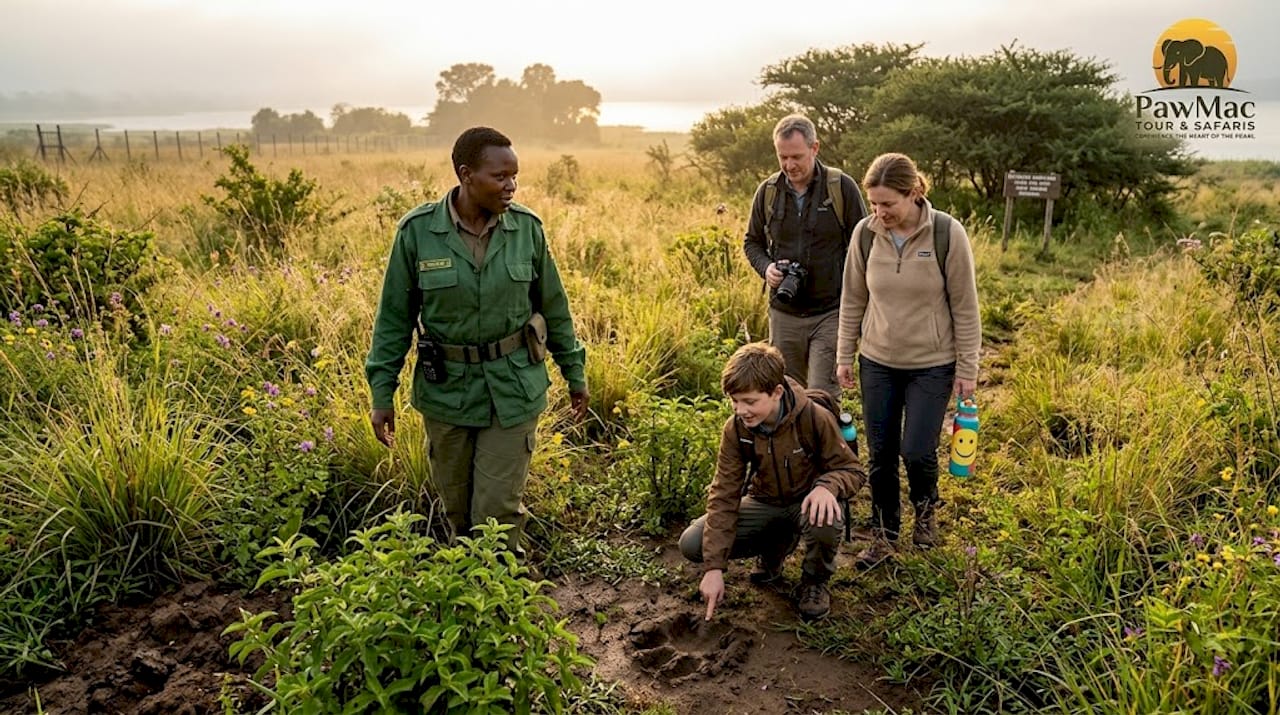
The pace is slow and intentional. Guides communicate in whispers and hand signals. When you finally encounter a rhino, you stop at a distance that the animal is comfortable with, which can range from 10 to 30 meters depending on the individual and the herd’s mood. Guides maintain authority over the group’s behavior at all times.
What makes Ziwa rhino tracking ethically sound:
- Strict visitor behavior rules are enforced before and during the walk
- Guides have full authority to end a walk if visitors fail to comply
- No flash photography, sudden movement, or loud noise is permitted
- Conservation education is woven throughout the experience
- Ranger narration covers individual rhino histories, breeding records, and monitoring methods
The sanctuary’s approach is closer to field conservation work than tourism entertainment. You will hear stories about specific rhinos that have been named and tracked since birth. Rangers speak about their animals with the familiarity of people who have shared a landscape with them for years.
Pro Tip: Wear earth-toned, neutral clothing and closed hiking shoes. Bright colors can startle wildlife and mark you as a less experienced tracker. Lightweight long pants protect against grass cuts and insects in the low vegetation.
Ziwa is also a strong option for family-friendly rhino tracking, with rangers adapting their explanations for younger visitors. If your Uganda itinerary also includes gorilla trekking in Uganda, Ziwa makes an excellent first stop on the way north before you head south to Bwindi.
Knowing what rhino tracking looks like, the next important detail is the cost and how fees support conservation.
Ziwa rhino sanctuary tracking costs and what they cover
Tracking fees at Ziwa are fixed and publicly listed, which removes the uncertainty that complicates budgeting for many safaris. The commonly quoted tracking fees are structured by residency status, as shown in the table below.
| Visitor category | Tracking fee |
|---|---|
| Foreign non-residents | $50 USD |
| Foreign residents | $40 USD |
| East African citizens | 30,000 UGX |
| Children (under 15, foreign) | Reduced rate applies |
| Children (East African) | Reduced rate applies |
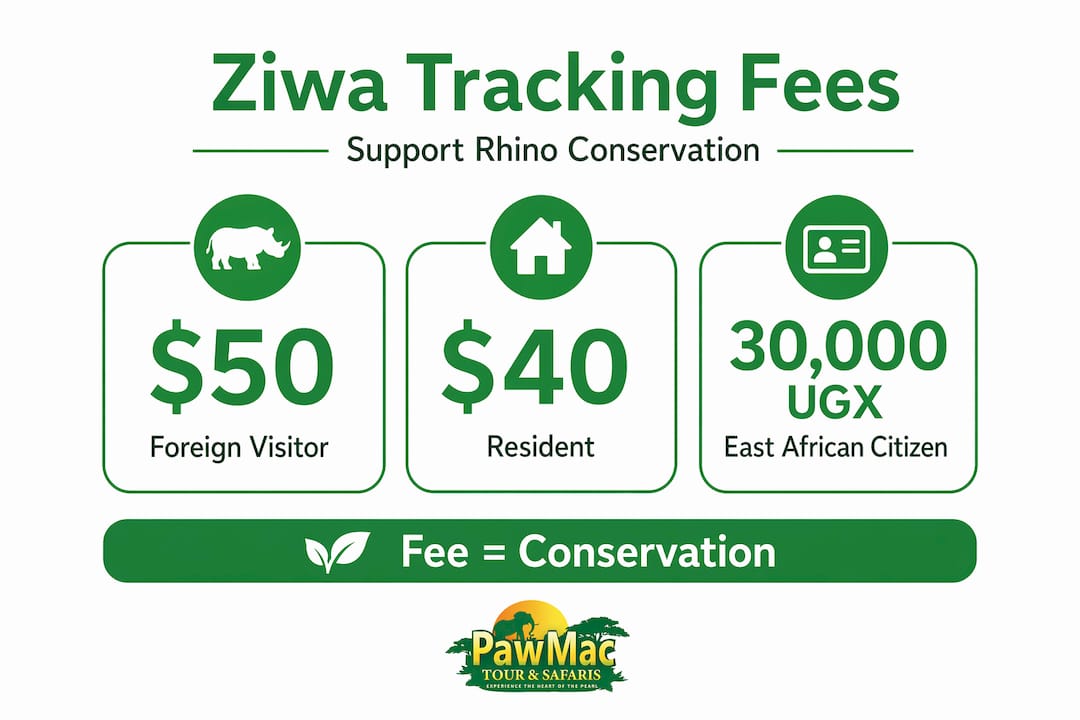
These fees do not fluctuate with group size or season, which makes safari budgeting for Ziwa straightforward. A couple traveling as foreign non-residents should plan for $100 USD for the tracking permits alone, separate from transport, accommodation, and any additional sanctuary activities.
Where your fees go:
- Ranger salaries: The 24/7 patrol team relies heavily on permit revenue for operational funding
- Rhino monitoring: Daily tracking logs, veterinary checks, and population management
- Electric fence maintenance: The perimeter fence requires continuous technical upkeep
- Community programs: Local villages adjacent to the sanctuary benefit from a share of revenue
- Sanctuary infrastructure: Guest facilities, signage, and conservation education resources
There is also a practical enforcement side to understand. Visitors who violate sanctuary rules during a walk can face fines, and guides are authorized to remove non-compliant guests without refund. This is not heavy-handed. It reflects genuine protection protocols built around animal welfare rather than visitor comfort.
Pro Tip: Book and pay for your tracking permits in advance through your safari operator. Walk-in spots exist but are not guaranteed, particularly during peak dry season months when Ziwa is busiest.
For a full picture of how Ziwa fits into a larger Uganda trip, browse the range of Uganda safari tours that include sanctuary access as part of multi-day itineraries.
With fees clarified, understanding how to book and prepare for your visit is key for a smooth experience.
Planning your Ziwa rhino tracking visit: booking and preparations
Booking a Ziwa rhino sanctuary tracking visit is not complicated, but doing it correctly avoids last-minute frustrations, especially if you are combining it with other Uganda wildlife activities that have tighter permit windows.
Step-by-step booking process through PawMac Safaris:
- Contact PawMac with your travel dates, group size, and nationality details
- Confirm whether you are combining Ziwa with Murchison Falls or another northern Uganda destination
- PawMac secures your rhino tracking permits and coordinates timing with the sanctuary
- A deposit is requested for gorilla permits or hotels where applicable
- Receive your itinerary confirmation with transport and guide details
- Prepare USD cash for any on-site payments not pre-arranged electronically
- Arrive at the sanctuary and proceed directly to check-in with your pre-confirmed permit
The PawMac booking process covers seven stages from initial contact through permits to final payment, with 4×4 safari vans provided for all transport. This is especially important for Ziwa, which sits off the main highway and requires vehicle clearance to access safely.
What is typically included when booking through PawMac:
- 4×4 safari van transport with experienced driver-guide from Kampala or your starting point
- Tracking permits arranged and pre-paid to secure your slot
- Accredited guides who understand both the sanctuary’s protocols and the broader conservation story
- Flexible itinerary design to combine Ziwa with Murchison Falls or Kidepo Valley National Park
Regarding payment, USD cash is widely accepted across Uganda’s national parks and sanctuaries, and it is advisable to carry small bills. Electronic payment options have expanded, and PawMac can advise on the best payment method for your specific booking.
Explore the full range of PawMac safari packages to find an itinerary that matches your travel style, whether you prefer a focused two-day Ziwa and Murchison Falls combination or a longer circuit through northern Uganda.
You can also browse related tracking experiences to understand how Ziwa compares to primate tracking in terms of difficulty, duration, and experience.
Having laid out the logistics, let’s look at why PawMac is a trusted partner for your ethical tracking safari.
Why choose PawMac Safaris for your Ziwa rhino sanctuary tracking
Ziwa is a straightforward sanctuary to visit independently, but the experience changes meaningfully when you travel with people who know Uganda’s wildlife landscape deeply. PawMac Safaris combines Polish-founded management with years of on-the-ground Ugandan expertise, producing a hybrid of European operational reliability and authentic local knowledge.
What sets PawMac apart for Ziwa rhino tracking tours:
- Local knowledge: PawMac guides understand how to time your Ziwa visit alongside Murchison Falls activities for maximum efficiency
- Ethical commitment: The company actively supports sanctuaries and conservation programs aligned with Uganda’s wildlife goals
- Vehicle comfort: Well-maintained 4×4 safari vans with pop-up roofs and adequate space for gear, cameras, and binoculars
- Transparent pricing: No hidden fees, clear permit cost breakdowns, and honest advice on what each category of traveler should budget
- Personalized itineraries: Whether you are traveling as a couple, a family, or a small group, PawMac designs routes that make practical sense and minimize wasted travel time
The company’s approach mirrors the values behind the sanctuary itself: prioritize the animal, respect the environment, and ensure visitors leave with genuine understanding rather than just photographs. Their safari safety practices, outlined in their safari safety tips resources, reflect this same care.
PawMac also qualifies as one of Uganda’s trusted safari operators for family groups, with guidance on age-appropriate activities, child permit rates, and safe vehicle configurations for young travelers.
Understanding the service provider completes your preparation for an unforgettable rhino tracking adventure.
Rethinking wildlife tracking: why Ziwa rhino sanctuary is a model for ethical tourism
The wildlife tourism industry struggles with a persistent contradiction. Visitors want proximity. Conservation requires distance. Most wildlife attractions solve this by letting tourism expand until it presses against whatever boundary is left, then calling it close enough. Ziwa takes the opposite approach.
The tracking experience at Ziwa is designed from the conservation side outward, not from visitor demand inward. Visitors’ tracking experiences fit within a long-term population management pipeline rather than being recreational activities grafted onto a conservation site. The sanctuary collects behavioral data from every tracked walk. Rangers log rhino positions, group compositions, and any unusual stress responses. Your visit generates real field data.
This is the part most wildlife tourism misses entirely. When you see a gorilla in Bwindi or an elephant in Queen Elizabeth, the encounter is meaningful but largely passive from a conservation standpoint. At Ziwa, the monitoring infrastructure means your presence and the resulting ranger activity actively contribute to population management records. Every walk adds to the dataset that guides breeding decisions and herd health assessments.
Ethical wildlife tourism earns that label when the animals benefit directly from visitor access, not just indirectly through funding. Ziwa meets that test. The question worth asking of any wildlife attraction is whether the encounter serves the animal’s long-term interests or only satisfies the visitor’s short-term curiosity. Ziwa’s answer is clear, and it offers a model that other sanctuaries in Africa would do well to study.
With the ethical importance clear, consider how you can join this impactful experience by booking with experts.
Plan your ethical Ziwa rhino tracking adventure with PawMac Safaris
PawMac Safaris specializes in building Uganda itineraries that combine ecological depth with genuine logistical ease. A Ziwa Rhino Sanctuary visit pairs naturally with a Murchison Falls safari, creating a northern Uganda circuit that takes in rhino tracking, Nile delta boat cruises, and savanna big game in under four days.

Spots at Ziwa fill quickly during peak season, and early booking in 2026 secures the best dates for both tracking permits and accommodation near the sanctuary. PawMac handles the full coordination, from permits and guide assignments to comfortable 4×4 transport and ethical access aligned with sanctuary rules. Browse the full Uganda wildlife tours catalog to find the right match for your group, or request a 2026 safari quote directly via the PawMac contact page or WhatsApp for a personalized itinerary and fast, transparent pricing.
Frequently asked questions
How much does rhino tracking at Ziwa Rhino Sanctuary cost?
Tracking fees are approximately $50 for foreign non-residents, $40 for foreign residents, and 30,000 UGX for East African citizens, with lower rates available for children.
How long does a typical rhino tracking walk last at Ziwa?
Tracking walks generally last between one and two hours depending on where the rhinos are grazing on that particular day.
Is rhino tracking at Ziwa safe and ethical?
Yes. Ziwa is enclosed by a two-meter electric fence and guarded by a dedicated ranger team operating around the clock, ensuring both visitor safety and the welfare of the rhinos during every tracked walk.
How can I book a rhino tracking safari at Ziwa?
You can book through PawMac Safaris, who manage the full process including permits, 4×4 transport, and accredited guide assignments, contact them via the website or WhatsApp with your travel dates and group details.
What months are best for rhino tracking at Ziwa Sanctuary?
The best tracking conditions fall during the dry seasons from June to August and December to February, when walking paths are firmer and vegetation is lower, though the sanctuary remains accessible and rewarding year-round.
Recommended
- Essential tips for responsible safaris in Uganda: ethical wildlife
- Top African Safari Destinations for Ethical Wildlife Adventures
- Uganda primate tracking: gorillas, chimps & golden monkeys
- Role of safari guides in Uganda: 50% safer wildlife encounters


