


- 413 Views
- 10 Min Read
- (0) Comment
Planning a Big Five safari in Uganda can feel overwhelming when you see prices ranging from $600 to over $3,000 per person. Many travelers assume these adventures are out of reach or worry about hidden fees inflating their budget. This guide breaks down every cost component for 2026, from park entry fees and rhino tracking permits to transport and accommodation, giving you the transparency needed to budget accurately. You’ll discover how timing, package inclusions, and booking strategies directly impact your total spend, empowering you to plan a memorable Ugandan wildlife experience without financial surprises.
Table of Contents
- Understanding The Main Cost Components Of A Big Five Safari In Uganda
- What’s Typically Included And Excluded In 2026 Big Five Safari Packages In Uganda
- How Timing, Duration, And Safari Type Affect Big Five Safari Costs In Uganda
- Additional Costs To Budget For On Your Uganda Big Five Safari In 2026
- Plan Your 2026 Uganda Big Five Safari With Pawmac Safaris
- FAQ
Key takeaways
| Point | Details |
|---|---|
| Park fees vary by location | Murchison Falls charges $45 daily while Queen Elizabeth National Park costs $40 per person for 24 hours |
| Rhino tracking has fixed costs | Ziwa Rhino Sanctuary requires $70 total per person, split between $50 tracking and $20 entry |
| Transport adds significant expense | Private 4×4 safari van hire averages $150 daily including driver and fuel |
| Season affects pricing dramatically | High season rates increase 20-30% compared to shoulder months like March or November |
| Direct booking saves money | Local operators eliminate 15-20% platform commission fees charged by third-party booking sites |
Understanding the main cost components of a Big Five safari in Uganda
Every Uganda safari involves costs like park entry fees, permits, and accommodation that vary based on your chosen destinations and wildlife priorities. Park and reserve entry fees differ significantly across Big Five locations. Murchison Falls National Park charges foreign non-residents $45 per person for each 24-hour period, while Queen Elizabeth National Park costs $40 daily. Lake Mburo National Park, home to zebras and buffaloes, has lower rates at $35 per day.
Rhino tracking at Ziwa Rhino Sanctuary carries separate fees totaling $70 per person. This breaks down to $50 for the guided tracking experience and $20 for sanctuary entry. The tracking session typically lasts 1.5 to 2 hours with armed rangers.
Accommodation spans three tiers affecting your budget substantially. Budget lodges near parks start around $80-120 per night for double occupancy. Mid-range tented camps with en-suite facilities run $180-280 nightly. Luxury lodges with premium amenities command $350-600 per night.
Ground transport represents a major expense since Uganda safari prices and permits require reliable 4×4 vehicles for park access. Private safari van hire averages $150 daily, covering the vehicle, experienced driver, and fuel. This rate applies whether you’re solo or traveling in a group of six, making group travel more economical per person.
Professional guides and trackers come included in reputable packages, adding value through wildlife expertise and safety protocols. Their knowledge dramatically improves sighting success rates and enriches your understanding of ecosystems.
Pro Tip: Booking combined packages covering multiple parks often reduces overall costs by 15-25% compared to arranging each component separately, since operators negotiate bulk rates with lodges and eliminate duplicate transport routing.
What’s typically included and excluded in 2026 Big Five safari packages in Uganda
Understanding package inclusions prevents budget shocks and helps you compare operators accurately. Most Big Five safari packages include accommodation, meals, park fees, and guides as standard components. Ground transportation in customized 4×4 safari vans with pop-up roofs for optimal viewing appears in nearly all packages. Daily meals typically cover breakfast, packed lunches during game drives, and dinners at lodges.
Park entry fees for your planned destinations get bundled into the quoted price, eliminating the need to pay separately at each gate. Experienced driver-guides who double as wildlife trackers are standard inclusions, providing navigation and animal behavior insights throughout your journey.
Plan Your Uganda Safari with Local Experts
 WhatsApp Us
Common exclusions require separate budgeting to avoid surprises. International flights to Entebbe never appear in safari packages, nor do domestic flights if you choose air transfers. Travel insurance covering medical evacuation and trip cancellation remains your responsibility. Uganda visa fees of $50 for single-entry tourist visas must be paid independently through the online portal.
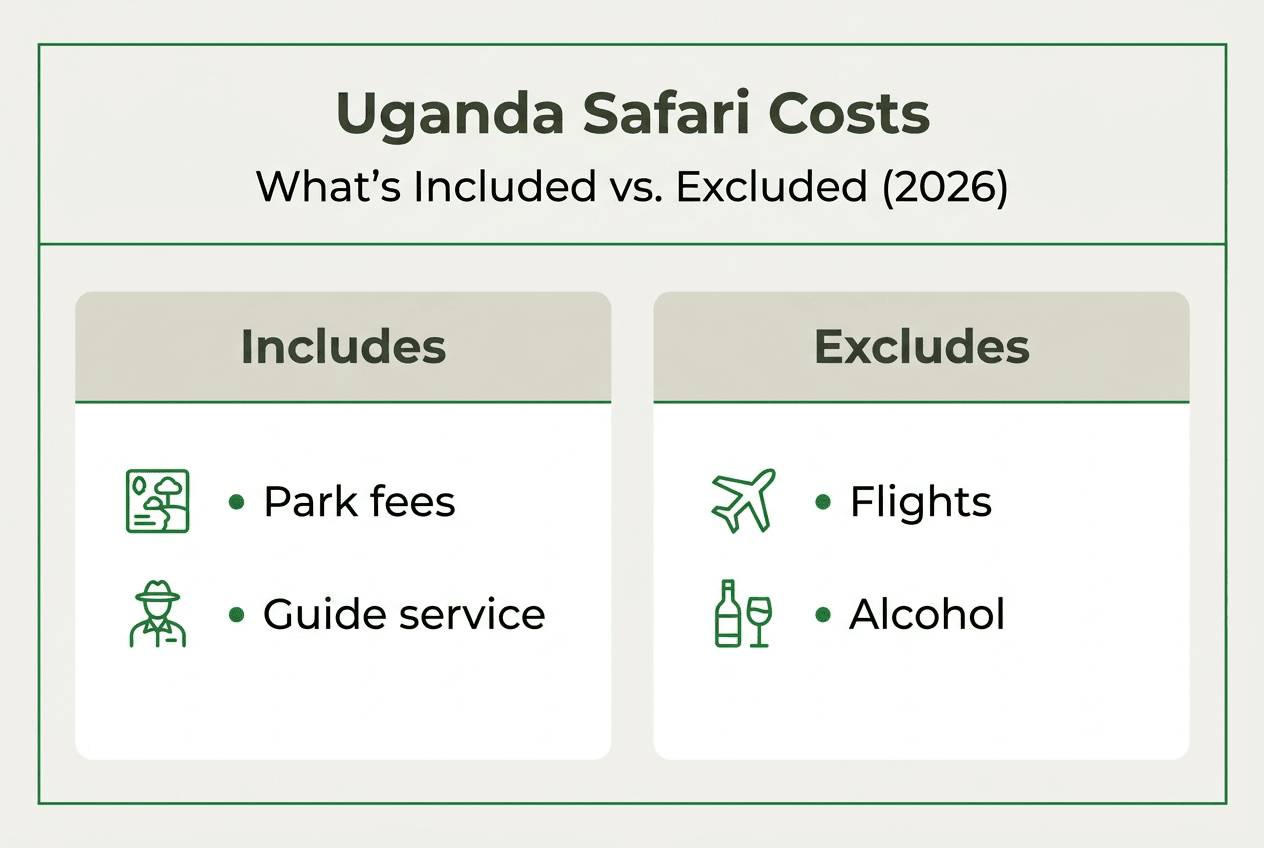
Alcoholic beverages and soft drinks outside of meals typically cost extra at lodges. Gratuities for guides, drivers, and lodge staff are customary but excluded from package prices. Optional activities like boat cruises on the Kazinga Channel ($30 per person) or chimpanzee tracking permits ($200) may or may not be included depending on your 3-day Big Five safari package selection.
Gorilla trekking permits at $800 per person represent the biggest variable. Some operators bundle these into comprehensive packages while others price them as add-ons. Always confirm permit inclusion explicitly before booking.
Personal gear like binoculars, safari clothing, and photography equipment falls outside package coverage. Refer to a Uganda safari packing guide to identify what you need to bring versus what lodges provide.
Pro Tip: Request itemized cost breakdowns showing exactly which fees are included versus optional, allowing you to compare packages accurately across different operators and identify the best value for your priorities.
How timing, duration, and safari type affect Big Five safari costs in Uganda
Seasonal pricing fluctuations and trip length create significant cost variations for identical itineraries. High season from June through September and December through February commands premium rates as global demand peaks during these dry months. Lodge prices increase 25-35% and availability tightens, requiring bookings 4-6 months ahead.
Safari prices vary by season, with low season offering cheaper rates but different wildlife viewing conditions. March through May and October through November represent shoulder seasons where you’ll find 20-30% lower accommodation costs while still enjoying good wildlife visibility. These months balance budget considerations with reasonable weather.
Safari duration impacts both total spend and daily averages. Three-day Big Five safaris covering Murchison Falls and Ziwa typically cost $600-900 per person in groups of two or more. Five-day itineraries adding Queen Elizabeth National Park range from $1,200-1,800 per person. Seven-day comprehensive tours including multiple parks run $2,000-3,200 per person. Longer safaris reduce daily costs through economies of scale but increase absolute expenditure.
| Safari Type | Duration | Avg Cost Per Person | Typical Inclusions |
|---|---|---|---|
| Budget | 3 days | $600-750 | Basic lodges, shared van, park fees |
| Mid-range | 5 days | $1,400-1,650 | Tented camps, private van, most meals |
| Luxury | 7 days | $2,800-3,200 | Premium lodges, exclusive guides, all activities |
Choosing your ideal package involves these steps:
- Determine your absolute budget ceiling including all extras like tips and gear.
- Identify must-see animals and prioritize parks accordingly (rhinos require Ziwa, tree-climbing lions need Queen Elizabeth).
- Select your preferred accommodation tier based on comfort expectations versus cost sensitivity.
- Compare discounted gorilla safari booking tips if adding primate tracking to your Big Five experience.
- Review Uganda safari packages pricing across multiple operators to identify competitive rates.
Pro Tip: Booking during shoulder seasons like April or November delivers 25-30% cost savings while maintaining 80-90% of peak season wildlife viewing quality, making it the sweet spot for budget-conscious travelers.
Additional costs to budget for on your Uganda Big Five safari in 2026
Beyond package prices, several mandatory and optional expenses require financial planning to avoid shortfalls. Uganda visa fees of $50 for single-entry tourist visas apply to most nationalities and must be paid online before arrival. Yellow fever vaccination certificates are mandatory for entry, with the vaccine costing $150-200 at travel clinics if you’re not already immunized.
Travel insurance and tipping are important additional expenses to include in your safari budget. Comprehensive coverage including medical evacuation, trip cancellation, and emergency repatriation typically costs 4-7% of your total trip value. For a $2,000 safari, expect $80-140 in insurance premiums. Medical evacuation from remote parks to Kampala hospitals can exceed $10,000 without coverage, making this expense non-negotiable.
Tipping represents a cultural expectation and budget item often overlooked by first-time safari travelers. Driver-guides typically receive $10-15 per day per group. Lodge staff including waiters and housekeepers get $3-5 daily. Rhino trackers at Ziwa appreciate $5-10 per person after successful sightings. For a 5-day safari, budget $100-150 total for gratuities.
Gear purchases or rentals add up quickly for travelers lacking safari-appropriate equipment. Quality binoculars cost $150-400 if purchased new, though many lodges offer complimentary loaners. Neutral-colored clothing suitable for game drives runs $80-150 for a complete outfit from retailers like Decathlon. Camera equipment rentals for telephoto lenses average $40-60 daily.
| Expense Category | Typical Range | Budgeting Notes |
|---|---|---|
| Uganda Visa | $50 | Single-entry, paid online |
| Yellow Fever Vaccine | $150-200 | One-time cost, valid 10 years |
| Travel Insurance | $80-200 | 4-7% of trip value |
| Tipping (5 days) | $100-150 | Guides, staff, trackers |
| Safari Gear | $80-250 | Clothing, binoculars if needed |
Essential planning steps to avoid financial surprises:
- Confirm visa requirements 8 weeks before departure to allow processing time
- Purchase comprehensive safari travel insurance covering evacuation and cancellation
- Withdraw sufficient US dollars in small denominations for tips since rural areas lack ATMs
- Inventory your existing gear against packing lists before buying new equipment
- Budget 15-20% above your package price to cover all additional expenses comfortably
Disclaimer: Pawmac Safaris does not provide, recommend, or compare travel insurance providers. This information is for general educational purposes regarding Ugandan logistics only.
For personalized cost estimates and itinerary planning, contact Pawmac Safaris directly with your travel dates and group size.
Plan your 2026 Uganda Big Five safari with Pawmac Safaris
Now that you understand the complete cost structure, turning your Big Five safari from concept to confirmed booking becomes straightforward. Pawmac Safaris specializes in transparent, locally-operated Uganda safari tours designed specifically for 2026 travelers seeking authentic wildlife experiences without middleman markup.

Our packages range from efficient 3-day Big Five safaris covering Murchison Falls and Ziwa to comprehensive week-long adventures exploring multiple ecosystems. Every itinerary includes customized 4×4 safari vans with pop-up roofs, experienced Ugandan driver-guides, and detailed cost breakdowns showing exactly what you’re paying for.
Booking directly with a local operator eliminates the 15-20% commission fees charged by international platforms, reducing your costs while supporting Ugandan tourism businesses. Our team provides personalized quotes based on your specific travel dates, group size, and accommodation preferences, ensuring you get competitive pricing matched to your budget tier.
Explore detailed Uganda safari packages and pricing to compare options, or reach out for customized itineraries that align perfectly with your wildlife priorities and financial parameters. We handle all permit bookings, lodge reservations, and logistics coordination, letting you focus on the adventure ahead.
FAQ
How much should I budget daily for a Big Five safari in Uganda?
Daily costs range from $200 to $600 per person depending on accommodation tier and group size. Budget travelers using basic lodges and joining small groups spend $200-280 daily. Mid-range safaris with tented camps average $350-450 per day. Luxury experiences at premium lodges cost $500-600 daily, including all meals, park fees, and private guides.
Are gorilla trekking permits included in Big Five safari package prices?
Gorilla permits at $800 per person are sometimes bundled into comprehensive packages but often priced separately as optional add-ons. Always confirm permit inclusion explicitly when comparing quotes, since this single item represents 30-40% of a typical 5-day safari budget. Some operators list base prices excluding permits to appear more competitive.
What is the best time to visit Uganda for affordable Big Five safaris?
March through May and October through November offer the lowest prices while maintaining good wildlife viewing. These shoulder months deliver 20-30% savings on accommodation compared to peak season. Best time to visit Uganda balances cost with weather, though expect occasional afternoon rain showers during these periods.
Can I customize the length and activities in Uganda Big Five safaris?
Most operators including Pawmac allow full customization of itinerary duration and included activities. Personalizing your safari helps control costs by focusing budget on priority wildlife experiences while skipping optional add-ons. Customize your Uganda safari by contacting operators directly with your specific interests, available dates, and budget parameters for tailored quotes.
Recommended
- Uganda Safari Prices – Costs, Permits & Best Safari Packages
- Big Five Animals in Uganda: 5 Key Safari Insights (2026)
- Uganda Safari Packing Guide for Gorilla Treks and Big Five
- How to book a discounted gorilla safari in Uganda 2026


