


- 243 Views
- 11 Min Read
- (0) Comment
Table of Contents
- 2026 Logistics Summary by PawMac Safaris
- Key takeaways
- What is Bwindi Impenetrable National Park?
- Essential gorilla trekking logistics in Bwindi
- Conservation impact and community benefits of Bwindi gorilla tourism
- Planning your trip: permits, accommodations, and best times to visit Bwindi
- Plan your unforgettable Uganda safari with PawMac Safaris
- FAQs
Key Takeaways
| Point | Details |
|---|---|
| Park size and gorillas | Bwindi Impenetrable National Park covers 331 square kilometers in southwestern Uganda along the border with the Democratic Republic of Congo. |
| Gorilla population count | Approximately 459 mountain gorillas live across four sectors in habituated and non habituated groups. |
| Trekking logistics essentials | Ground transfers from Kampala take eight to ten hours in customized 4×4 Safari Vans, with sector briefings at 7 to 8 am and treks departing around 9 am, and porter hires typically 15 to 25 dollars. |
| Conservation and community benefits | As a UNESCO World Heritage Site, Bwindi supports conservation through gorilla protection and generates community benefits from tourism. |
2026 Logistics Summary by PawMac Safaris
- Gorilla trekking permits: $800 per person for Foreign Non-Residents
- Four operational sectors: Buhoma, Ruhija, Rushaga, Nkuringo
- Ground transfer from Kampala: 8-10 hours via customized 4×4 Safari Vans
- Daily trek briefings: 7-8am at sector headquarters, departures around 9am
- Porter hire: $15-25, essential for terrain navigation and load support
Bwindi Impenetrable National Park protects nearly half of the world’s remaining mountain gorillas across 331 square kilometers of dense montane forest in southwestern Uganda. PawMac Safaris manages ground logistics for travelers planning gorilla trekking expeditions to this UNESCO World Heritage Site, where approximately 459 endangered mountain gorillas live across four distinct trekking sectors. This guide covers essential operational details: permit requirements, sector selection, transport realities, accommodation alignment, trek protocols, and conservation context that shapes your 2026 planning decisions.
Key takeaways
| Logistics Factor | 2026 Reality |
|---|---|
| Park size | 331 km² UNESCO World Heritage Site |
| Mountain gorilla population | 459 individuals (nearly 50% of global total) |
| Trekking sectors | Buhoma, Ruhija, Rushaga, Nkuringo |
| Permit cost (FNR) | $800 per person |
| Ground transfer time | 8-10 hours from Kampala |
| Trek start time | 9am after 7-8am briefing |
| Group composition | 8 trekkers maximum per habituated family |
| Porter hire cost | $15-25 (strongly recommended) |
| Biodiversity | 120+ mammal species, 350+ bird species |
| Conservation revenue allocation | 20% to local communities and anti-poaching |
What is Bwindi Impenetrable National Park?
Bwindi Impenetrable National Park occupies 331 square kilometers of montane and lowland forest along Uganda’s southwestern border with the Democratic Republic of Congo. The park received UNESCO World Heritage designation in 1994 based on its exceptional biodiversity and role as a critical mountain gorilla sanctuary.
PawMac Safaris operates ground logistics across all four trekking sectors within the park. Elevation ranges from 1,160 to 2,607 meters, creating varied terrain that directly impacts trek difficulty and duration. The dense forest canopy and steep valleys define the physical environment you’ll navigate during gorilla tracking.
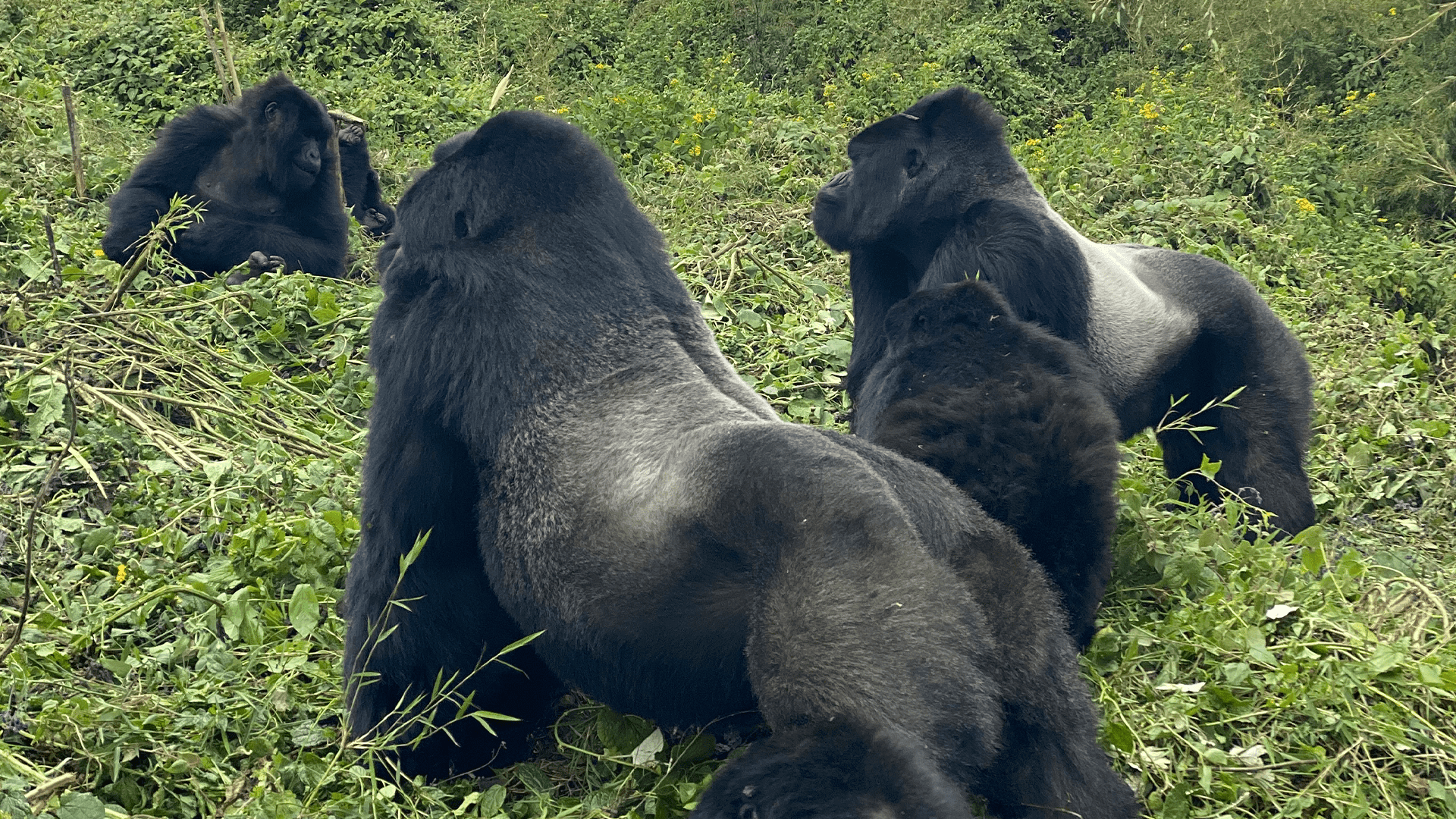
The park protects approximately 459 mountain gorillas distributed across habituated and non-habituated family groups. This represents nearly half of the global mountain gorilla population. Beyond gorillas, Bwindi hosts over 120 mammal species and more than 350 bird species, making it one of Africa’s most biodiverse protected areas.
Key biodiversity markers:
- 459 mountain gorillas across four sectors
- 120+ mammal species including forest elephants, duikers, and primates
- 350+ bird species with 23 Albertine Rift endemics
- Ancient forest ecosystem dating back over 25,000 years
- 200+ tree species and 100+ fern varieties
PawMac Safaris aligns sector selection with your fitness level and trek preferences. Buhoma and Nkuringo sectors typically require longer, steeper treks. Rushaga offers the highest concentration of habituated gorilla families, providing more permit availability. Ruhija sits at higher elevation with cooler temperatures and different vegetation zones.
The park’s impenetrable designation reflects real ground conditions. Thick undergrowth, steep slopes, muddy trails, and limited visibility define the trekking environment. This terrain reality drives our porter recommendation and equipment requirements for every client.
Pro Tip: Sector selection impacts trek difficulty more than gorilla sighting success. All habituated families maintain 95%+ daily location rates through professional tracker teams. Choose your sector based on physical capability and accommodation proximity, not gorilla guarantee assumptions.
Essential gorilla trekking logistics in Bwindi
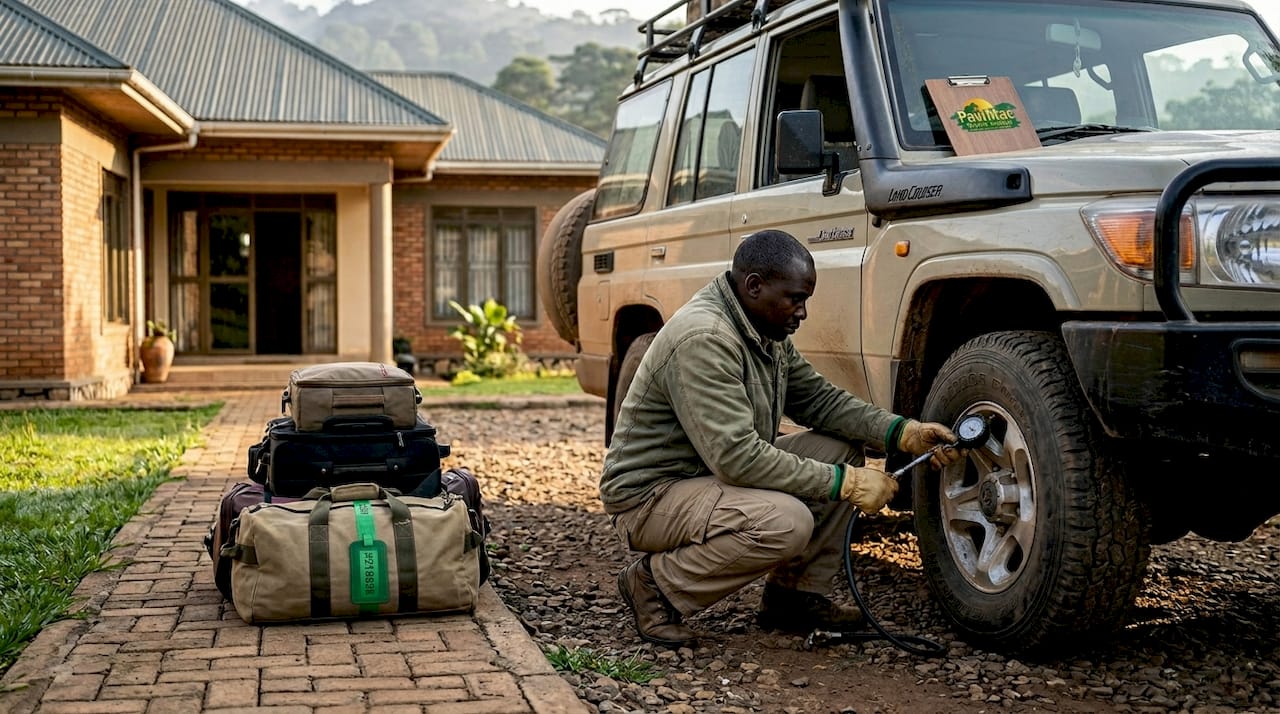
PawMac Safaris coordinates all ground logistics from Kampala to your assigned trekking sector. The standard transfer route covers 8-10 hours via paved and murram roads, requiring customized 4×4 Safari Vans with reinforced suspension for the final approach sections.
Plan Your Uganda Safari with Local Experts
 WhatsApp Us
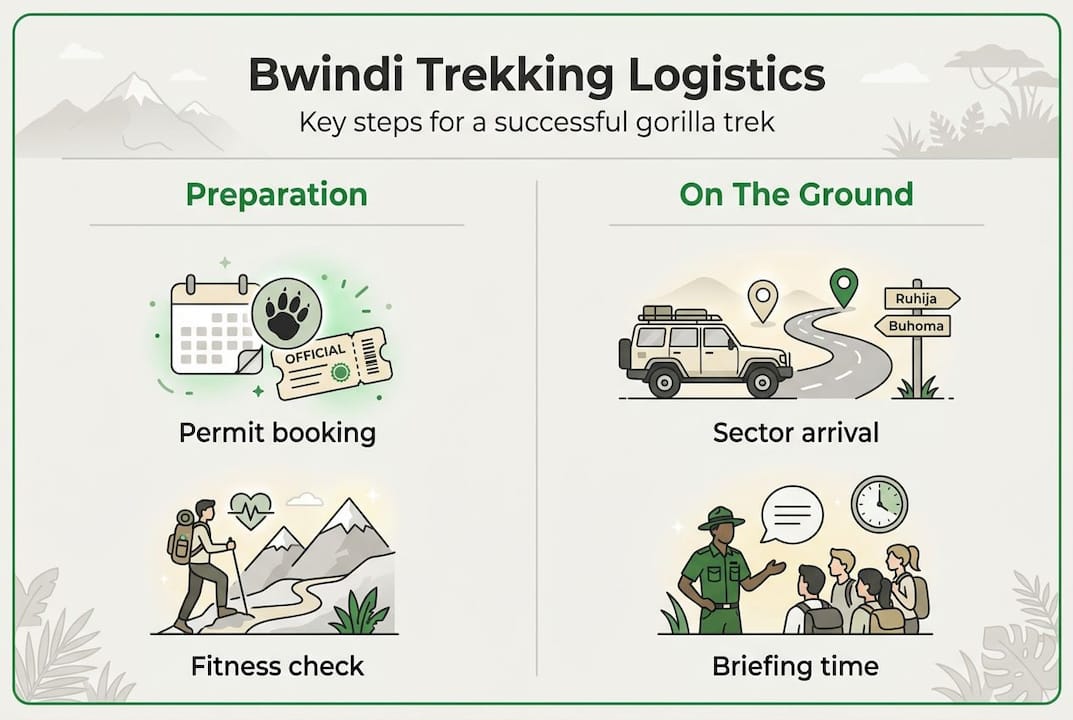
You must arrive at sector headquarters between 7-8am for the mandatory pre-trek briefing. Uganda Wildlife Authority rangers assign groups to specific gorilla families based on fitness declarations and permit allocation. Trek departures occur around 9am after briefing completion and final equipment checks.
Each trekking group includes eight visitors maximum, one armed ranger, one lead guide, and tracker support staff who locate the assigned gorilla family before your arrival. This group structure remains fixed regardless of sector or family assignment.
Standard trek day protocol:
- 7-8am: Sector headquarters check-in and briefing
- 8-9am: Porter hiring, final gear checks, group assignments
- 9am: Trek departure with ranger and guide team
- Variable duration: 2-8 hours depending on gorilla location
- 1 hour: Maximum time with gorilla family after contact
- Afternoon: Return to headquarters, certificate collection
Porter hire costs $15-25 and provides essential support beyond simple load carrying. Porters navigate optimal routes, assist with steep sections, and provide stability on muddy descents. PawMac Safaris recommends porter hiring for all clients regardless of fitness level, as this directly supports local community income while improving your trek safety and comfort.
Permit procurement requires advance booking through authorized channels. The $800 Foreign Non-Resident permit grants one trek to one habituated family on your assigned date. No permit transfers, refunds, or date changes occur except for documented medical emergencies or UWA-initiated cancellations.
Transport and timing realities:
- Kampala to Buhoma: 8-9 hours (460 km)
- Kampala to Rushaga: 9-10 hours (510 km)
- Final 30-40 km: Murram roads requiring 4×4 capability
- Overnight stop recommended at sector accommodation
- Same-day return to Kampala not operationally viable
PawMac Professional Ground Logistics ensures vehicle condition, driver experience, and route timing align with early morning briefing requirements. We do not offer fly-in options or same-day return transfers due to road condition realities and mandatory early sector arrival.
Pro Tip: Book permits 4-6 months ahead for dry season dates (June to September, December to February). Rushaga sector offers the most permit availability due to higher habituated family numbers, but all sectors maintain equivalent gorilla encounter success rates.
Conservation impact and community benefits of Bwindi gorilla tourism
Uganda Wildlife Authority allocates 20% of gorilla trekking permit revenue to local community development projects and conservation programs. This revenue-sharing model funds schools, health clinics, water infrastructure, and direct household payments in parishes surrounding the park.
Anti-poaching operations receive sustained funding through tourism revenue. Ranger patrols, snare removal teams, and habitat monitoring programs operate year-round regardless of visitor numbers. The economic value of live gorillas to local communities creates incentive structures that reduce poaching pressure and habitat encroachment.
PawMac Safaris operates within strict ethical protocols that protect gorilla health and minimize behavioral disruption. You must maintain seven meters minimum distance from all gorillas during your one-hour encounter period. Masks are mandatory to reduce respiratory disease transmission risk. No eating, drinking, or flash photography occurs in gorilla presence.
Ethical trekking requirements:
- Seven-meter minimum distance from all gorillas
- Surgical masks mandatory during encounter hour
- No direct eye contact with silverbacks
- Voices kept to whispers, no sudden movements
- Maximum one hour with gorilla family
- No trekking permitted if you show cold or flu symptoms
“The revenue model transforms local communities from park opponents to conservation partners. Direct economic benefits create household-level incentives to protect gorilla habitat and report poaching activity.” — Uganda Wildlife Authority Community Conservation Framework
Porter hiring provides direct community income beyond permit revenue sharing. Most porters come from parishes immediately adjacent to sector boundaries. The $15-25 daily rate represents significant household income in rural southwestern Uganda, creating tangible economic links between tourism activity and local livelihoods.
PawMac Safaris prioritizes Uganda’s operational advantages for gorilla trekking logistics. The $800 permit cost, higher gorilla population numbers, and four-sector distribution create better availability and planning flexibility compared to single-park alternatives in neighboring countries.
Habituated gorilla families undergo multi-year conditioning processes before receiving trekking permits. Trackers monitor family movements daily, maintaining location accuracy that ensures 95%+ encounter success rates. This professional tracking infrastructure protects both visitor experience quality and gorilla welfare by preventing extended search periods or multiple group approaches.
Planning your trip: permits, accommodations, and best times to visit Bwindi
PawMac Safaris secures gorilla trekking permits through direct Uganda Wildlife Authority coordination. The $800 Foreign Non-Resident permit must be paid in full at booking confirmation. Permit availability fluctuates by sector and month, with Rushaga maintaining the most consistent availability due to nine habituated families versus three to four in other sectors.
Accommodation selection must align with your assigned trekking sector. PawMac Safaris coordinates sector-specific lodging to ensure you reach headquarters by 7am briefing time. Cross-sector morning transfers are not operationally viable given road conditions and distance realities.
PawMac Safaris 2026 Accommodation Standards by Sector:
| Category | Buhoma Options | Rushaga/Nkuringo Options | Nightly Rate Range |
|---|---|---|---|
| Luxury | Buhoma Lodge, Sanctuary Gorilla Forest Camp | Clouds Mountain Gorilla Lodge, Nkuringo Gorilla Camp | $400-800 |
| Mid-range | Haven Lodge, Silverback Lodge | Gorilla Valley Lodge, Ichumbi Gorilla Lodge | $150-300 |
| Budget | Buhoma Community Rest Camp | Rushaga Gorilla Camp, Nkuringo Campsite | $30-80 |
Dry season months (June to September, December to February) provide optimal trekking conditions. Trails remain more navigable, mud depth decreases, and gorilla families often range at lower elevations. Wet season months (March to May, October to November) bring heavier rainfall, deeper mud, and more challenging terrain navigation.
PawMac Safaris maintains operations year-round. Gorilla families remain accessible in all months, and encounter success rates do not drop during wet seasons. The primary planning consideration involves your comfort with muddy, slippery trail conditions rather than gorilla availability.
Step-by-step permit and trip booking sequence:
- Contact PawMac Safaris with preferred travel dates and sector preference
- Confirm permit availability for your specific dates
- Provide passport details and full payment for permit procurement
- Receive permit confirmation from Uganda Wildlife Authority
- Finalize accommodation based on assigned sector
- Confirm ground transport logistics from Kampala or Entebbe
- Review pre-trek preparation requirements and packing list
Permit demand peaks during July-August and December-January periods. PawMac Safaris recommends 4-6 month advance booking for these high-season windows. Shoulder months (June, September, February) typically maintain better availability while still offering dry season conditions.
Pro Tip: Rushaga sector provides the best permit availability buffer for last-minute planning due to nine habituated families versus three to four in other sectors. If your dates are fixed and other sectors show no availability, Rushaga often maintains open permit slots.
PawMac Safaris coordinates complete safari packages that combine gorilla trekking with additional Uganda wildlife activities. Multi-day itineraries allow proper sector transfer timing and reduce the compressed schedule pressure of standalone gorilla trek arrangements.
Accommodation booking must occur after permit confirmation, not before. Your assigned trekking sector determines viable lodging options. PawMac Safaris does not recommend booking accommodation before permit sector assignment, as this creates potential morning transfer complications or missed briefing scenarios.
Plan your unforgettable Uganda safari with PawMac Safaris
PawMac Safaris manages complete ground logistics for gorilla trekking expeditions and extended Uganda safari itineraries. Our operational control covers permit procurement, sector-aligned accommodation booking, 4×4 transport coordination, and pre-trek preparation guidance.
We operate with direct Uganda Wildlife Authority coordination for real-time permit availability across all four Bwindi sectors. Our customized 4×4 Safari Vans handle the murram road approaches to sector headquarters while maintaining schedule reliability for mandatory 7-8am briefing arrivals.

PawMac Safaris builds complete safari packages that extend beyond single-day gorilla treks. Multi-day itineraries incorporate Queen Elizabeth National Park wildlife drives, Kibale Forest chimpanzee tracking, and Murchison Falls boat safaris into comprehensive Uganda experiences with optimized ground transfer routing.
Our team provides detailed pre-trek consultations covering fitness requirements, packing essentials, sector selection criteria, and realistic trek duration expectations. We align your physical capability profile with appropriate sector assignments to optimize both safety and encounter quality.
Contact PawMac Safaris for permit availability confirmation, sector recommendations, and complete itinerary planning for your 2026 gorilla trekking expedition.
FAQs
What is the best time of year to visit Bwindi Impenetrable National Park?
Dry seasons from June to September and December to February provide optimal trekking conditions with less mud and more stable trail surfaces. Gorilla families remain accessible year-round with 95%+ encounter rates in all months. Wet season treks (March to May, October to November) require higher mud tolerance but offer lower accommodation rates and fewer trekkers on trails.
How do I obtain a gorilla trekking permit for Bwindi?
PawMac Safaris secures permits through direct Uganda Wildlife Authority coordination after you provide passport details and full $800 payment. Permits must be booked 4-6 months ahead for dry season dates due to limited daily allocation per habituated family. Each permit grants one trek to one assigned gorilla family on your specified date with no transfers or refunds except documented medical emergencies.
What should I pack for gorilla trekking in Bwindi?
Sturdy waterproof hiking boots with ankle support, rain jacket, long pants, long-sleeve shirt, gardening gloves for grabbing vegetation, and surgical mask are essential items. Pack a small daypack, 2-3 liters water, energy snacks, insect repellent, and sun protection. Hire a porter ($15-25) to carry your pack and provide navigation assistance on steep, muddy sections. Review the complete preparation checklist before departure.
Are there accommodation options inside Bwindi Impenetrable National Park?
Multiple lodges operate within and immediately adjacent to park boundaries across all four sectors, ranging from $30 budget campsites to $800 luxury properties. Staying at sector-specific accommodation ensures you reach headquarters by 7am briefing time without cross-sector morning transfers. PawMac Safaris coordinates accommodation booking after permit sector assignment to guarantee proper morning logistics alignment.
Recommended
- Uganda Safari Guide 2026: Gorilla Permits & Logistics
- Gorilla Trekking in Uganda: Cost, Permits & Tours 2026
- Gorilla Trekking Uganda 2026 – Permits, Prices & Best Safaris
- Why Uganda is the best gorilla trekking destination 2026


